
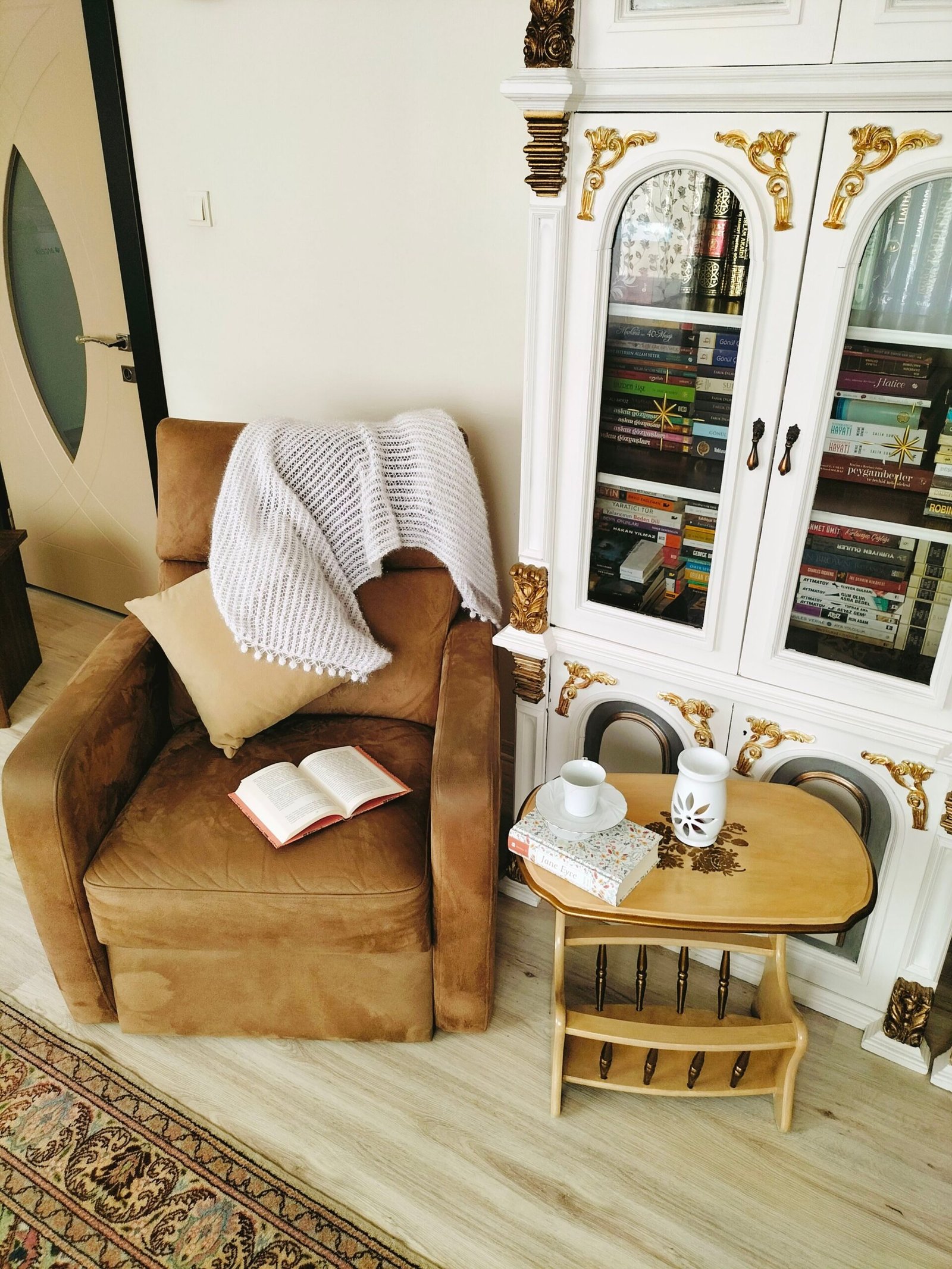
You do not need a spare room, a window seat, or a library to have a reading corner. You need a chair you like sitting in, light you can read by, somewhere to put a drink and a book, and a corner of your living room that is quiet enough to settle into. Most living rooms already have such a corner — it is just currently occupied by a plant nobody waters, a chair nobody sits in, or nothing at all.
This guide shows how to create a reading corner in your living room without a renovation and without buying a full set of new furniture. It covers finding the quietest corner you have, choosing the chair and light that matter most, adding a surface and storage within reach, and making the corner inviting rather than merely functional — because a reading corner that is not inviting will not be used, however well it is equipped.
Find the Quietest Corner You Have
The best reading corner is not necessarily the prettiest corner. It is the quietest one: the spot furthest from the television, away from the main walkway through the room, and out of the direct path between the door and the kitchen. A corner that is passed through constantly will never feel restful, however comfortable the chair is, because every passer-by breaks concentration.
Look for a corner near a window if you can, because daylight is the best reading light and a window gives you something pleasant to look at when you pause. A corner beside a bookshelf is ideal for obvious reasons, and a corner near a fireplace has natural warmth and atmosphere in the evening. If none of those is available, any corner that is out of the main traffic flow will do — the chair and light matter more than the view.
Size is less of an obstacle than people think. A reading corner needs room for a chair, a small side table, and a lamp — roughly the footprint of a single armchair plus a little extra. Measure the corner you have in mind and check that a chair can sit there with room to get in and out comfortably, and that the side table will be within arm’s reach of the seated position. If the corner is very tight, a smaller chair or a chair without wide arms may fit better than a large, enveloping one.
The Chair and Light Matter Most
If you buy or choose only two things for a reading corner, make them the chair and the light, because these two determine whether the corner gets used. A reading chair needs to support you comfortably for an hour or more: a back high enough to lean against, arms at a height that lets you rest a book or your elbows, and a seat deep enough to tuck your legs up or stretch them out. Test a chair by sitting in it with a book for ten minutes, not by looking at it. A beautiful chair that makes your back ache after twenty minutes is not a reading chair.
Foot support matters too. A footstool, ottoman, or pouffe that lets you put your feet up transforms a chair from a seat into a reading spot, and it is often the difference between a corner that is used daily and one that is admired but avoided. The footstool does not need to match the chair — a simple upholstered ottoman in a complementary colour works well — but it should be light enough to move easily and stable enough to rest your feet on without sliding.
Light is the other essential, and it has a simple rule: the light should come from behind or beside you, over your shoulder, so it falls on the page without shining in your eyes or casting your own shadow across the book. A floor lamp with an adjustable arm, placed behind and slightly to one side of the chair, is the classic solution, and it works for the same reason it has always worked. A table lamp on a side table beside the chair can work too, provided it is tall enough and bright enough to light the page without glare.
Evening light should be warm rather than harsh. A warm-toned bulb in the reading lamp makes the corner feel inviting in the evening and is easier on the eyes than a stark white light. If the corner is also used during the day, natural light from a nearby window is ideal, but check for glare on the page at different times of day — a sheer curtain or a slight change of chair angle can fix glare without blocking daylight. For a fuller explanation of how reading light fits into a room’s overall lighting, see How to Layer Lighting to Make Any Room Feel Cosy, and for lighting that serves television, reading, and conversation together, Living Room Lighting Ideas for Daytime and Evening Use covers the balance in detail.
Reading chair checklist
- Can you sit in it for an hour with a book without fidgeting or aching?
- Is the back high enough to lean against, and are the arms at a comfortable height?
- Can you put your feet up, on a footstool or ottoman, without the arrangement feeling cramped?
- Does light fall on the page from behind or beside you, without glare or shadow?
- Can you get in and out of the chair easily, without moving other furniture?
A Surface and Storage Within Reach
A reading corner without a surface is a corner where books, drinks, and glasses end up on the floor. A small side table, within arm’s reach of the seated position, is essential — and it does not need to be large. A table just big enough for a mug, a book, and a pair of glasses is perfect. A table that is too large will crowd the corner and make it feel cramped; a table that is too far away will not be used.
Storage for books should also be within reach, or at least within a few steps. A small bookshelf beside the chair, a basket for current reads, or a stack of books on the side table itself all work. The point is not to store your whole library in the corner, but to have the book you are currently reading — and the next one — close at hand, so settling into the chair does not require a trip across the room.
A basket or a small shelf for reading accessories — a bookmark, reading glasses, a notebook, a phone charger — keeps the corner tidy without requiring a large piece of furniture. A blanket or throw, folded over the chair arm or kept in a basket beside it, is also worth having, because a reading corner is often used in the evening when the room cools down, and being cold is a reliable reason to abandon a book.
Keep the surface clear of non-reading items. A side table that accumulates remotes, keys, and paperwork will stop feeling like part of a reading corner and start feeling like a dumping ground. A small tray on the table can help: it defines the table’s purpose and makes it easier to clear when it drifts into clutter.
Make It Inviting, Not Just Functional
A reading corner that is functional but not inviting will be used once and then forgotten. Inviting means soft, warm, and personal: a cushion that makes the chair more comfortable, a throw in a colour you like, a plant nearby, a piece of art on the wall beside the chair, or a candle on the side table. These are small touches, but they are what turn a chair in a corner into a place you look forward to sitting in.
Texture is particularly effective here. A wool throw, a velvet cushion, and a soft rug under the chair all signal comfort, and they make the corner feel distinct from the rest of the room even if the furniture is similar. A rug under the reading chair also defines the corner visually, marking it as its own small zone within the living room, which helps it feel private even in a shared space.
Personal touches matter more in a reading corner than in most parts of a room, because the corner is for one person. A photograph, a favourite book left open, a particular mug kept for reading time — these are the details that make a corner yours, and they cost nothing. A reading corner that reflects the reader is a corner that will be used.
Finally, protect the corner’s purpose. If the reading chair becomes the place where bags are dumped, laundry is folded, or children stack toys, it will stop being a reading corner, however well it is furnished. A gentle household rule — the reading chair is for reading — is worth more than any amount of decoration. And if the rest of the living room is already cosy, the reading corner will feel like a natural extension of it, as described in Cosy Living Room Ideas for Cold Evenings and Everyday Relaxing, where warmth, textiles, and light are built up in layers across the whole room.
FAQ: Creating a Reading Corner
How much space do I need for a reading corner?
Roughly the footprint of an armchair plus a small side table — often less than a square metre of floor beyond the chair itself. A corner that can fit a chair, a table within arm’s reach, and a floor lamp is enough. If space is very tight, a smaller chair or a wall-mounted lamp can save room.
What kind of lamp is best for reading?
A floor lamp with an adjustable arm, placed behind and slightly to one side of the chair, so light falls over your shoulder onto the page. The bulb should be warm-toned for evening comfort and bright enough to read by without straining. Avoid a light directly in front of you, which causes glare, and a light directly overhead, which casts shadows.
Can a reading corner work in a small living room?
Yes, and it often works better than in a large one, because a small room’s corners are naturally more enclosed and private. Choose a compact chair, a small side table, and a wall-mounted or slim floor lamp, and keep the corner’s footprint as small as possible while still being comfortable.
How do I stop the reading corner becoming a dumping ground?
Give everything in the corner a purpose and a home: a tray on the side table for small items, a basket for the current book and a throw, and a household understanding that the chair is for reading. A two-minute reset when you finish reading — book on the table, throw folded, mug taken away — keeps the corner inviting.
Conclusion
Creating a reading corner in your living room is a small project with a large return: find the quietest corner you have, choose a chair and a light that make reading comfortable, add a surface and storage within reach, and make the corner inviting with texture and personal touches. You do not need a spare room or a large budget — you need a chair you like, light that falls on the page, and a corner that is yours. Once those are in place, the hardest part is finding time to sit down, and that is a far pleasanter problem than not having anywhere to read at all.
1 thought on “How to Create a Reading Corner in Your Living Room”