
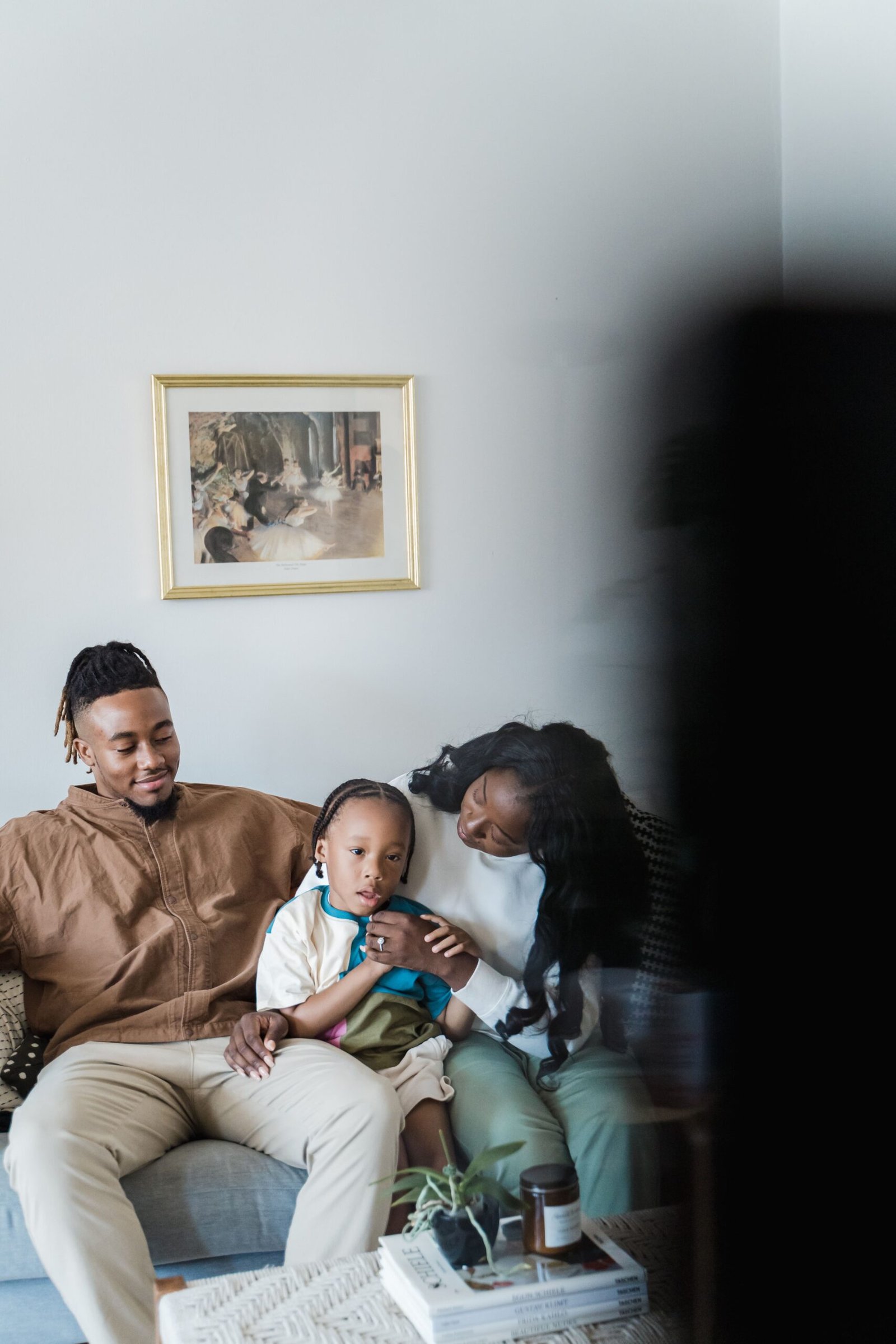
A family-friendly living room has a reputation problem. Mention it and most people picture a room given over entirely to children: plastic toys everywhere, a sofa covered in throws to hide the stains, and no trace of the adults who also live there. But a genuinely family-friendly room is not a playroom with a sofa in it. It is a room that works for everyone who uses it — children, pets, and adults alike — and still looks like a room you are proud of.
This guide is about that balance. It covers materials that survive real life, storage children can actually use, zones for play and for adults, and the simple idea of keeping one area looking smart even when the rest of the room is in full family use. The goal is a living room that does not need to be tidied for visitors before it looks presentable, and does not need to be childproofed into dullness to survive a normal week.
Choose Materials for Real Life
The single most important decision in a family-friendly living room is material, not style. A beautiful fabric that stains the first time a drink is spilled is not a good choice for a household with children or pets, however good it looks in a showroom. Washable, durable, and forgiving materials are what make a family room work, and they have improved enormously: many fabrics that look and feel like linen or velvet are now washable or stain-resistant, and many hard surfaces are far tougher than they appear.
For seating, look for removable, washable covers where possible, or for fabrics that can be spot-cleaned without leaving a mark. Darker colours and patterns hide marks better than pale, plain fabrics, but that does not mean a family sofa must be dark: a mid-toned, textured fabric in a warm neutral hides a surprising amount while still looking smart. Leather is another option worth considering — it wipes clean, and it often looks better with age — though it is not right for every household or budget, and it can feel cold in winter without throws and cushions.
For tables and surfaces, rounded corners are safer for small children than sharp ones, and materials that do not show every ring mark — wood with a durable finish, stone, or a good-quality laminate — will look better after a year of family use than a delicate surface that needs constant protection. A coffee table that can be wiped clean in seconds is worth more in a family room than a beautiful table that everyone is afraid to use.
Flooring follows the same logic. A rug that can be cleaned, or that is inexpensive enough to replace, is more practical in a family room than a precious rug that becomes a source of anxiety. Washable rugs, flat-weave rugs, and rugs in patterns that disguise marks all have a place here. The rug should also be large enough to define the seating area and soft enough for children to play on — a hard floor with no rug is neither comfortable nor forgiving in a family room.
Material choices that age well in family rooms
- Removable, washable sofa and cushion covers, so a spill is a laundry job, not a disaster.
- Mid-toned, textured fabrics that disguise marks better than pale, plain ones.
- Rounded-corner tables and durable table finishes that survive daily use.
- Washable or patterned rugs that can be cleaned or that hide wear gracefully.
- Paint finishes that can be wiped clean on walls near seating and play areas.
Storage Kids Can Actually Use
Storage in a family room fails when it is designed for adults and expected to be used by children. A high cupboard with a stiff latch will not be used by a five-year-old, however tidy it would keep the room. Storage children can actually use is low, open or easy to open, and clearly labelled — with pictures for younger children who cannot yet read, and with words for older ones.
Baskets and bins are the work horses of family storage. A large basket for soft toys, a bin for building blocks, a box for art supplies — each with a clear home, each light enough for a child to carry, and each easy to put things back into. The key insight is that tidying up must be easier than leaving things out, or it will not happen. A basket that a child can toss toys into in seconds will be used; a cupboard that requires stacking, sorting, and closing a door will not.
Low, open shelving works on the same principle. A low shelf with a few baskets, at a height children can reach, lets them choose and return their own toys and books, which builds independence as well as tidiness. Rotating toys — keeping some in storage and swapping them periodically — keeps the room from overflowing and makes old toys feel new again, which is a practical way to manage a growing collection without constantly buying more storage.
Adults need storage too, and it should be separate from children’s storage where possible. A closed cupboard or a high shelf for adult items — books, electronics, paperwork, breakables — keeps those things safe and keeps the room looking smart, while children’s storage stays open and accessible. This separation is what stops a family room from looking like a playroom: children’s things have their place, and adult things have theirs.
For a fuller treatment of children’s storage that adapts as children grow — low, labelled, adjustable systems rather than fixed themes — see Storage Ideas for Kids’ Rooms That Grow With Them, and for the wider habit of keeping a home tidy room by room, Decluttering Room by Room: A Practical Starter Plan covers a starter approach that works well for busy households.
Zones for Play and for Adults
A family living room works best when it is zoned, even informally, into areas for play and areas for adults. This does not mean building a wall or banishing children to a corner. It means that the main seating area is arranged for adults to sit and talk, while a defined play area — a rug, a low table, a basket of toys — gives children a place that is theirs, within sight and within the room, but not spread across the whole floor.
The play zone should be near the seating area, not isolated in another room, because young children want to be near adults and adults want to keep an eye on them. A corner of the living room with a small rug and a low storage unit is often enough. As children grow, the zone can change: a homework table replaces the toy basket, a gaming chair replaces the play mat, but the principle stays the same — a defined area for children’s activities within the shared room.
The adult zone, meanwhile, should be protected by the simple rule that it is for sitting, reading, and conversation, not for storage or play. A coffee table that is kept clear, a side table with a lamp and a book, and a sofa that is not used as a dumping ground all signal that this part of the room is for adults to enjoy. This is not about excluding children — children are welcome in the adult zone — but about keeping one part of the room calm and ordered, so the room as a whole does not feel chaotic.
Furniture arrangement helps here. A sofa with its back to the play zone creates a natural boundary, as does a rug that defines the seating area. A room divider, a bookshelf, or a change of flooring can mark the boundary more firmly if needed, but in most rooms a rug and a furniture arrangement are enough. The aim is a room where play and adult life coexist visibly but not chaotically.
Keep One Area Looking Smart
The most practical trick in a family-friendly living room is also the simplest: keep one area looking smart, even if the rest of the room is in use. That area might be a mantelpiece, a single wall with art and a console, a reading corner, or the seating area itself when it is tidied. When visitors arrive, the eye goes to the smart area first, and the room reads as cared for even if a toy basket is visible in the corner.
This works because a room does not need to be perfect to look smart; it needs one focal point that is ordered and intentional. A tidy mantel with a mirror and two objects, a console table with a lamp and a vase, or a bookshelf arranged with space around its objects all serve this purpose. The rest of the room can be in normal family use — toys in their baskets, a throw on the sofa, a book left open — and the room will still feel presentable.
Choosing the smart area is a matter of picking the spot visitors see first, which is usually the wall opposite the door or the area around the fireplace. Keep that spot clear of children’s storage and daily clutter, and let it be the room’s showcase. Everything else can be practical and lived in, which is how a family room should be.
Style is not sacrificed by any of this. A family room can borrow warmth from styles that suit it — natural materials, soft textures, and simple lines all work well with children and pets — and Modern Farmhouse Style Without the Clichés is a good example of a warm, practical style that survives family life without looking like a showroom or a playroom. The point is to choose a style that welcomes daily use rather than one that requires the room to be kept pristine.
FAQ: Family-Friendly Living Rooms
How do I keep a family living room from looking like a playroom?
Give children’s things a defined zone and closed or basket storage, keep adult items on separate shelves or in closed cupboards, and keep one area — a mantel, a wall, a console — looking smart. The room will read as a living room that welcomes children, not as a playroom that happens to have a sofa.
What is the best sofa fabric for a household with children?
Removable, washable covers are ideal, followed by durable, stain-resistant fabrics in mid-toned, textured finishes that disguise marks. Avoid pale, plain, delicate fabrics for main seating, and use throws and cushions — which are easier to wash — to add lighter colours.
Should children have their own play area in the living room?
Yes, if the living room is where the family spends most of its time. A defined play zone — a rug, low storage, and a small table — keeps toys contained and lets children play near adults, which is what most young children want. The zone can evolve as children grow, from toys to homework to gaming.
How often should a family living room be tidied?
A quick reset each evening — toys into baskets, surfaces cleared, throws folded — is more effective than a big weekly tidy. Children can be part of the reset if their storage is low and easy to use, and the habit keeps the room feeling calm without requiring perfection during the day.
Conclusion
A family-friendly living room that still looks smart is not a contradiction. It is a room planned for real life: materials that survive spills and daily use, storage children can actually use, zones that let play and adult life share a room without colliding, and one area kept looking smart so the room always feels cared for. Choose for durability first and style second, and the style will follow — because a room that works for everyone who lives in it is, by definition, a room that looks good lived in.
1 thought on “Family-Friendly Living Room Ideas That Still Look Smart”