
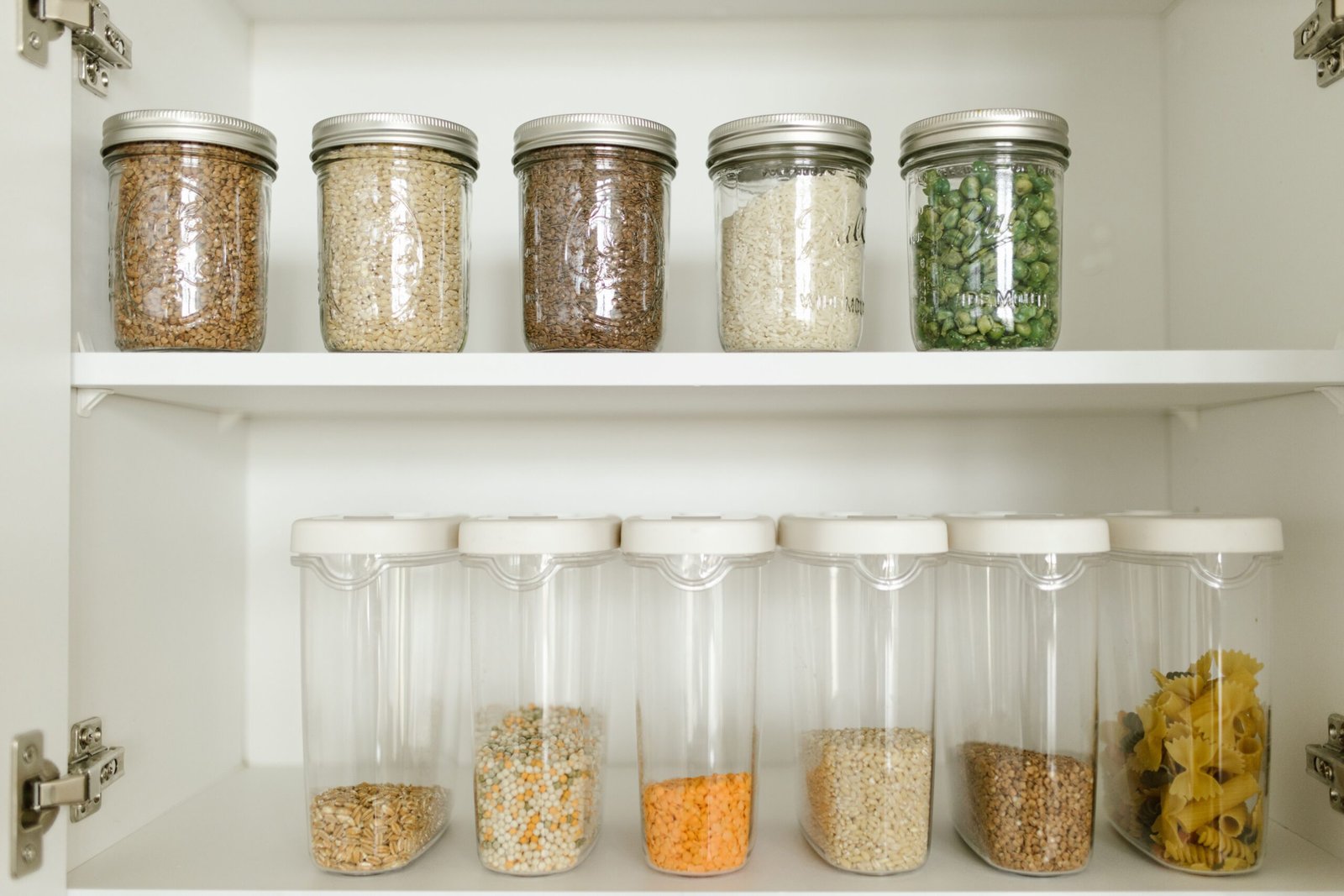
A pantry in a busy kitchen has to survive real life: hurried weekday cooking, a weekly shop unloaded in a rush, children or housemates reaching for snacks, and ingredients bought for one recipe and then forgotten. Most pantries fail not because they are small, but because they are organised by purchase date or not at all, so the thing you need is always behind three things you do not. A pantry that stays usable is one organised by how you cook, with everything visible and a restock habit that takes minutes.
This guide covers pantries and kitchen cupboards together, since in many homes they are the same thing: a few shelves, a cupboard, or a small dedicated space. The principles are the same at any size — group by use, make everything visible, use containers only where they earn their space, and restock in a short routine.
Group by How You Cook
Group pantry items by the way you actually cook, not by food type alone. Breakfast items together, everyday cooking staples together, baking items together, and snacks in one place, means you can gather everything for a meal from one or two spots rather than opening every cupboard. A “weeknight cooking” group — oils, sauces, tinned tomatoes, pasta, rice, stock — is often the most-used group of all, and it deserves the most accessible shelf.
Within each group, put the most-used items at the front and at eye level, and the rarely used items higher or further back. This sounds obvious, but most pantries do the opposite: new shopping gets pushed in front of older items, so the back of the shelf becomes a museum of forgotten ingredients. When you unload shopping, put new items behind existing ones of the same type, so older items get used first and nothing expires unnoticed at the back.
Keep a small “use first” spot for items nearing their date, opened packets, and half-used ingredients. A single basket or a front-row position for these items means they get noticed and used, rather than discovered months later when they are past their best. Labelling the basket, or simply making it the first thing you see when you open the cupboard, is enough.
Make Everything Visible
Visibility is the pantry’s biggest problem, especially on deep shelves. The most useful tools are turntables for oils, sauces, and small jars; stepped shelf risers so back rows are visible above front rows; and baskets or bins that can be pulled out like drawers on deep shelves. Each of these costs little and prevents the common failure of buying a duplicate because the original was hidden.
Labelling helps where containers are used, but it is not a substitute for visibility. A shelf of identical, unlabelled jars looks tidy in a photograph and is confusing in daily use. If you decant into jars, label them plainly with the contents and, where useful, the date opened. If labelling feels like a chore you will not maintain, skip decanting altogether — original packaging with its label and date is perfectly functional, and a tidy original is better than an unlabelled jar.
Keep the pantry’s front edge clear of clutter. Small items that migrate to the front — single sachets, loose packets, stray lids — block access to everything behind them. A small basket for loose packets, kept to one basket, stops this drift. It also helps to keep the pantry’s most-used group at the height you reach without thinking: the everyday cooking staples should be at eye level or just below, not on the top shelf where they require a step stool, and not on the bottom shelf where they require crouching with a heavy tin in hand. Small ergonomic details like this matter in a busy kitchen, because a pantry that is awkward to use will be used carelessly, and careless use is what undoes organisation fastest. Design the pantry around the cook’s actual reach, and the system will largely maintain itself.
The same visibility thinking applies to kitchen cupboards generally, and How to Organize Kitchen Cabinets So Everything Is Easy to Reach covers cupboard layout in more detail, while workspace in a small kitchen is addressed in Small Kitchen Ideas That Add Workspace Without a Renovation.
Containers That Earn Their Space
Containers are the most oversold pantry product. They help for specific problems — flour and sugar that spill, cereals that go stale, small items that scatter — but a pantry full of matching containers, each holding a half-empty ingredient, takes up more space than the original packaging and adds washing and refilling work. Use containers only where they solve a real problem, and choose a small number of sizes that stack neatly.
Good candidates for containers are ingredients you buy in bulk and use often: flour, sugar, rice, oats, and coffee. Poor candidates are ingredients you use rarely, buy in small amounts, or that come in packaging that already works well, such as tins, jars, and sealed packets. For those, the original packaging, stored upright in a basket or on a riser, is the better choice.
- Decant: flour, sugar, rice, oats, coffee — bulky, spill-prone, frequently used.
- Keep in original packaging: tins, jars, sealed packets, rarely used ingredients.
- Use baskets for: loose packets, snack bars, sachets, and small items that scatter.
- Use a turntable for: oils, vinegars, sauces, and small jars on deep shelves.
One more rule: one container per ingredient, and no empty containers stored in the pantry. Empty containers waiting for a refill are clutter, and they multiply quietly. Keep spares elsewhere, or better, keep only the containers currently in use.
It is also worth giving the pantry a little breathing room on purpose. A pantry packed to the edges is hard to use, because every item pulled out disturbs its neighbours and nothing can be seen at a glance. Leaving one shelf, or one section of a shelf, partly empty makes the whole pantry easier to navigate: new shopping has somewhere to go without shoving, and the items you reach for daily are not wedged behind a wall of stock. This is especially true for households that buy in bulk or shop less often, where the temptation is to fill every gap. A pantry with a little empty space is not a wasted pantry; it is a pantry with room to work. If space is genuinely tight, the answer is usually to keep less stock of rarely used items, rather than to cram more containers into the same shelves.
A Restock Routine That Takes Minutes
A pantry stays organised only if restocking is a routine, not a rescue mission. The simplest routine is a running list: a notepad, a phone note, or a small whiteboard in the kitchen, where anyone who finishes an item writes it down immediately. That list becomes the shopping list, which prevents both running out mid-recipe and buying duplicates of things already hidden at the back.
Once a week, or when the weekly shop arrives, spend five minutes on the pantry: put new items behind old ones, move anything near its date to the “use first” spot, and remove anything empty or expired. That five minutes is the whole maintenance routine, and it is far easier than a quarterly clear-out of a pantry that has drifted into chaos.
Seasonal or occasional ingredients — baking supplies used at holidays, specialist sauces bought for one recipe — should be reviewed a few times a year. If something has sat unused for a year, it is unlikely to be used next year either, and letting it go frees space for ingredients you actually cook with. The same review habit keeps a home office calm too, and Home Office Organization Ideas for a Calmer Workday applies the same short-routine thinking to a workspace.
FAQ: Pantry Organization
Should I decant everything into matching jars?
No. Decant only bulky, spill-prone staples you use often, such as flour, sugar, and rice. Tins, jars, and sealed packets work well in their original packaging, and unlabelled jars are confusing in daily use.
How do I stop buying duplicates?
Make everything visible with turntables, risers, and pull-out baskets, and keep a running shopping list that anyone who finishes an item adds to immediately.
What is the best way to use deep shelves?
Pull-out baskets or bins that slide out like drawers, plus turntables for small jars. Both let you reach the back without moving everything in front.
How often should I tidy the pantry?
Five minutes when the weekly shop arrives is enough: new items behind old ones, near-date items to the front, and anything empty or expired removed.
Conclusion
A pantry that stays usable in a busy kitchen is organised by how you cook, kept visible with a few practical tools, and maintained by a five-minute restock routine. Containers help only where they solve a real problem, and the original packaging is often the better choice.
Start by grouping items by use and pulling everything forward so you can see it. That one clear-out, plus a running shopping list, will change how the kitchen feels every day.