
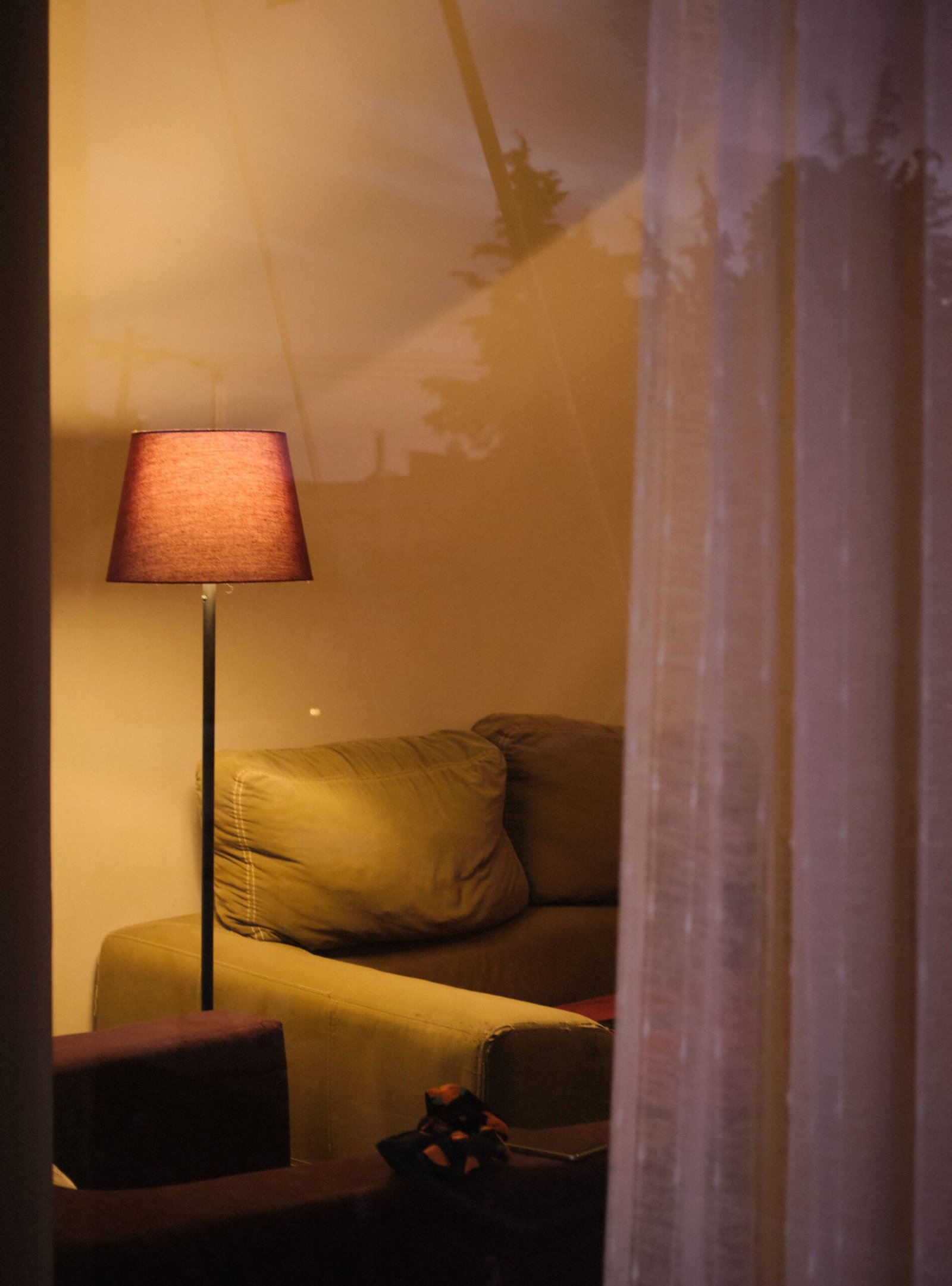
A living room at noon and the same living room at nine in the evening are, in effect, two different rooms. At noon it needs daylight, clarity, and enough brightness to feel open and welcoming. In the evening it needs warmth, softness, and light that flatters people rather than exposing them. A single lighting setup cannot serve both, which is why so many living rooms feel either too harsh in the evening or too dim during the day.
This guide treats daytime and evening as two lighting plans for one room. It covers daylight first — curtains, mirrors, and layout — then evening layers, with lamps favoured over overhead light, then light for the room’s three evening activities: television, reading, and conversation. Finally, it covers simple controls that make switching between day and evening lighting easy, because a lighting plan that is awkward to use will not be used.
Daylight First: Curtains, Mirrors and Layout
Daylight is free, flattering, and better than any artificial light, so the first job of living room lighting is not to add lamps but to make the most of the daylight the room already gets. Start by looking at the windows: are curtains or blinds blocking light even when they are open? Heavy curtains that cover part of the window when drawn back, or blinds that sit low in the frame, can cut daylight significantly. Lighter curtains, curtains hung wider than the window so they clear the glass when open, and blinds that can be raised fully all let more daylight in without any other change.
Mirrors are the classic daylight tool, and they work best when placed opposite or beside a window, where they reflect daylight deeper into the room. A large mirror on the wall opposite the main window can effectively double the feeling of light, and it makes a room feel larger at the same time. A mirror placed where it reflects a dark wall or a cluttered corner, by contrast, will reflect darkness and clutter, so position matters more than size.
Layout affects daylight too. Tall furniture in front of a window blocks light and casts shadows across the room, while low furniture near windows lets light travel further. A sofa with its back to a window is usually fine, because it is low, but a tall bookcase in front of a window is a daylight thief. If a room is dark during the day, check what is standing between the window and the rest of the room before buying more lamps.
Evening Layers: Lamps Over Overhead Light
In the evening, the rule reverses: the overhead light should be the last resort, not the first choice. A single bright ceiling light in the evening makes a room feel exposed and flat, because it lights everything equally and creates harsh shadows. Several smaller lamps, at different heights and in different parts of the room, create pools of warm light that feel intimate and flattering, and they let different parts of the room serve different purposes at the same time.
The three layers of evening light are ambient, task, and accent, and a living room needs all three. Ambient light is the general background light — a floor lamp with an uplight, a pair of table lamps, or a dimmed overhead light — that lets you move around the room safely and see people’s faces. Task light is focused light for a specific activity: a reading lamp beside a chair, a lamp over a work surface, or a light near a puzzle or a game. Accent light is decorative light that highlights something: a picture light over art, a small lamp on a shelf, or candles on a mantel.
Most living rooms have too much ambient light from a single overhead source and too little task and accent light. The fix is usually to add lamps rather than to replace the overhead light: a floor lamp beside the sofa, a table lamp on a side table, and a small lamp or candle on a shelf will transform an evening room without any wiring. Choose warm-toned bulbs for evening lamps — warm white rather than cool white — because warm light feels cosier and is kinder to skin tones in the evening.
Dimming is the single most useful evening lighting feature, and it is worth adding where possible. A dimmer on the overhead light, or lamps with built-in dimmers, lets you adjust the room’s brightness to the activity: brighter for a family gathering, dimmer for a film or a quiet evening. Even without dimmers, having lamps on separate switches achieves much of the same flexibility, because you can turn on only the lamps you need.
The principles of layering — ambient, task, and accent light working together rather than a single source doing everything — are explained in full in How to Layer Lighting to Make Any Room Feel Cosy, and they apply to every room in the house, not just the living room.
Light for TV, Reading and Conversation
Evening lighting needs to serve three activities that want different things, and the trick is to light each activity’s area separately rather than lighting the whole room for one activity at the expense of the others.
For television, the room should be dim but not dark. A completely dark room strains the eyes during long viewing, because the contrast between the bright screen and the dark room is too great. A small amount of background light — a lamp behind the television, a dim lamp in a corner, or a low light on a side table — reduces that contrast and makes viewing more comfortable. Avoid a bright light directly behind the viewer, which reflects on the screen, and avoid a lamp beside the television that shines into viewers’ eyes. The television area itself should be the darkest part of the room, with light elsewhere providing the background glow.
For reading, the light should be focused, bright enough to read by without straining, and positioned so it falls on the page from behind or beside the reader. A floor lamp with an adjustable arm beside a reading chair is the standard solution, and it works. A table lamp on a side table can work too, provided it is tall enough and its shade directs light downwards onto the page. Reading light should be warmer than task light for work, because it is used in the evening when the room is otherwise dim, and it should be switchable independently so it can be turned on without lighting the whole room. A dedicated reading spot makes this much easier to achieve, as covered in How to Create a Reading Corner in Your Living Room.
For conversation, the light should be warm, soft, and at face height or below, so people’s faces are lit flatteringly and the room feels intimate. Table lamps and floor lamps at seating height do this well; overhead lights do not, because they cast shadows downwards and make faces look harsh. Candles, used safely, are the classic conversation light for the same reason: they are low, warm, and flickering, which softens a room in a way no electric light quite matches. A room lit for conversation will feel welcoming even to people who are not part of the conversation, which is why restaurants use this kind of lighting.
When a room must serve all three activities at once — one person watching television, one reading, and two talking — separate, switchable lamps are essential. Each activity’s lamp can be turned on or off independently, so the room adapts to who is using it rather than forcing everyone into one lighting mode. This is the practical payoff of layering: flexibility, not just atmosphere.
Simple Controls That Make It Easy
A lighting plan is only as good as its controls. A room with five lamps, each with its own switch in a different place, will end up with only one or two lamps used, because turning them all on and off is a chore. Simple controls — a single switch that controls several lamps, a remote control, a smart plug, or simply lamps grouped on one power strip with a single switch — make the difference between a layered lighting plan and a plan that exists only on paper.
Low-tech controls work just as well. A power strip with a single switch, placed where it can be reached easily, turns several lamps on and off together. A lamp with a pull chain or a touch control is easier to use than one with a switch hidden behind furniture. And a simple routine — lamps on at dusk, overhead light off, reading lamp on when needed — is a control system in itself, and it costs nothing.
Finally, check the controls from the places where you actually sit. A switch beside the door is useful when you enter a room, but a switch beside the sofa is useful when you are already sitting down and want to dim the lights for a film. A room with controls in both places — or with a remote — will be lit well far more often than a room where adjusting the light requires getting up.
The same control thinking applies to the television arrangement itself: a room where the television, seating, and lighting are planned together will always work better than one where each was planned separately. For the seating side of that balance, see How to Arrange Furniture Around a TV Without Losing Style, which covers viewing distance, seating angles, and making the television wall part of the room.
FAQ: Living Room Lighting
How many lamps does a living room need?
Most living rooms need three or four light sources in the evening: one or two for ambient light, one for reading or task light, and one for accent. A room with only one light source will feel flat; a room with five or six can feel busy unless they are dimmed. Start with three and add more only if a specific area is still dark.
Should living room bulbs be warm or cool white?
Warm white for the evening, when the room is used for relaxing, television, reading, and conversation. Cool white can feel clinical in a living room in the evening, though it has a place in a workspace or a kitchen. If your lamps take different bulbs, choose warm white for the living room and keep cool white for task areas elsewhere.
How do I reduce glare on the television in the evening?
Move lamps so they are not directly behind viewers or beside the screen, use a dim background light rather than a bright one near the television, and avoid a lamp that shines directly onto the screen. A small light behind the television itself can reduce eye strain by softening the contrast between the screen and the dark room.
Can I improve daytime light without changing windows?
Yes. Use lighter curtains or hang them wider than the window, clean the glass, place a mirror opposite or beside the window, keep tall furniture away from windows, and choose light colours for the largest surfaces. Each of these increases daylight without any structural change.
Conclusion
Living room lighting works when day and evening are planned as two different rooms: daylight maximised with curtains, mirrors, layout, and light surfaces during the day, and warm, layered lamp light replacing harsh overhead light in the evening. Light each evening activity — television, reading, conversation — separately, and make the controls simple enough that the plan actually gets used. A room lit this way feels open and bright by day and warm and inviting by night, which is exactly what a living room should do.
2 thoughts on “Living Room Lighting Ideas for Daytime and Evening Use”