
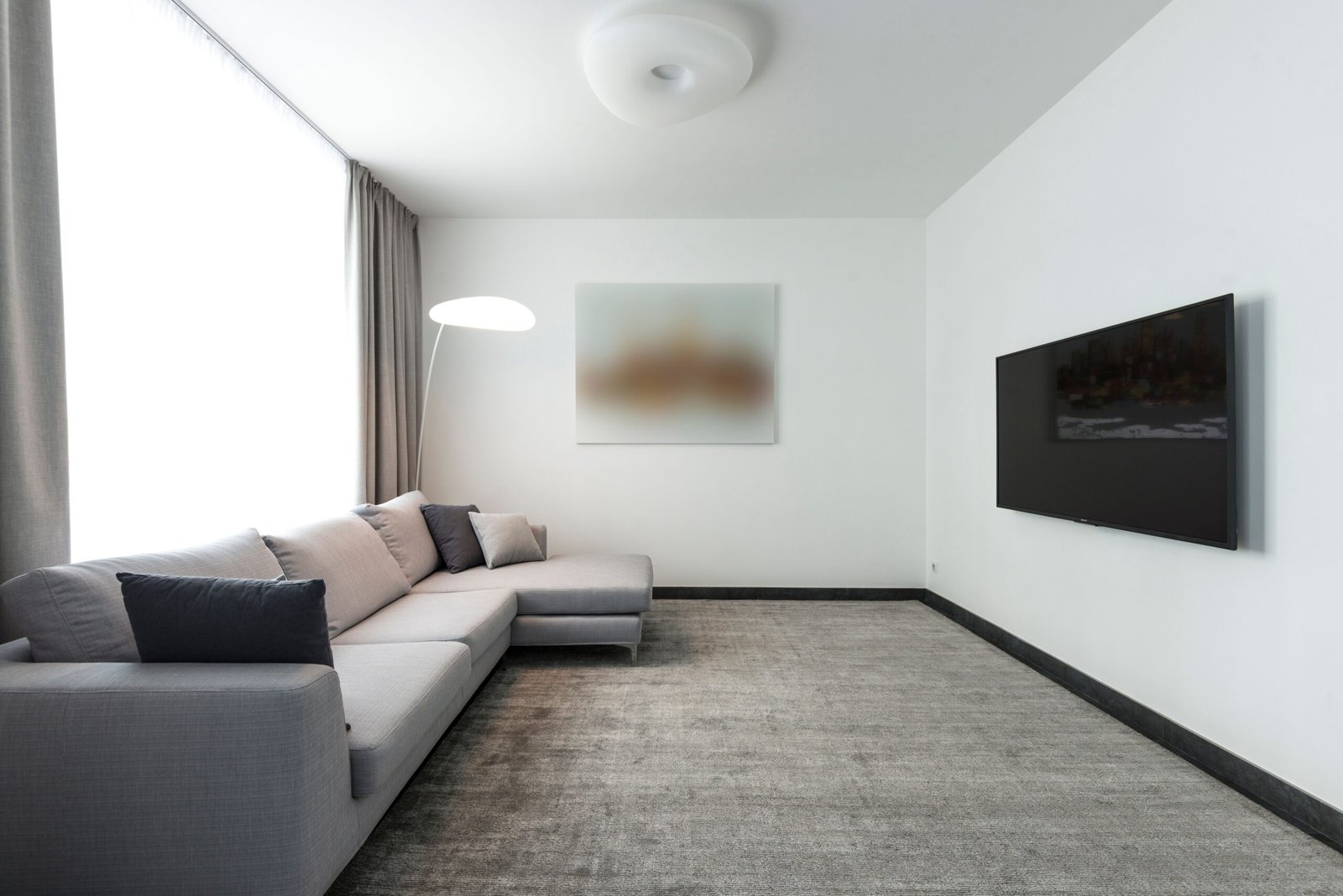
Almost every living room has a television, and almost every living room owner has the same dilemma: the television needs to be watchable, but nobody wants a room that looks like it exists only for a screen. Arrange the furniture purely for viewing and the room feels like a cinema with sofas. Arrange it purely for conversation and watching television becomes a neck-ache. The good news is that this is a solvable compromise, and it starts with getting a few practical details right rather than with buying anything new.
This guide covers how to arrange furniture around a TV without losing style: viewing distance and height, seating angles that work for both conversation and viewing, making the television wall part of the room rather than a black rectangle on it, and what to do when the television is deliberately not the focal point. The aim is a room that is comfortable to watch television in and pleasant to be in when the television is off.
Get Viewing Distance and Height Right
Viewing distance is the least glamorous part of television placement and the one that makes the most difference to comfort. Sit too close to a large screen and you will find yourself moving your head to follow the action; sit too far away and the picture feels small and distant. As a rough guide, the main seat should be far enough back that the whole screen fits comfortably in your field of view without turning your head, which for most living rooms means the sofa is not pushed right up against the opposite wall, nor jammed against the screen wall.
There is no single correct distance, because it depends on screen size, but a useful test is to sit in your usual seat and look at the screen: you should be able to see the whole picture, including the corners, without moving your head, and text on screen should be readable without squinting. If you have to move your head or lean forward, the seat is too close; if you find yourself wishing the picture were bigger, it is too far. Rearranging the seating by even a short distance can fix both problems, and it is worth testing before assuming you need a different television.
Height matters just as much. The centre of the screen should be roughly at eye level when you are seated, so your neck stays neutral. A television mounted too high — above a fireplace is the classic example — forces you to look up for hours, which is uncomfortable and tiring. A television sitting too low, on a very low stand, has the opposite problem. If your television is wall-mounted, check the height from your actual seat, not from standing height, and adjust the bracket if it is wrong. If it sits on a stand, the stand’s height is part of the decision, not an afterthought.
Angle Seating, Don’t Just Face the Screen
The most common television arrangement — a sofa directly opposite the screen, with everything facing it — is comfortable for watching but poor for conversation, because everyone sits in a row facing the same direction. Angling the seating slightly changes this without ruining the viewing experience. Two chairs angled towards each other and towards the screen, or a sofa and a chair arranged in an L shape, allow people to talk to each other naturally while still seeing the screen comfortably.
The key is that the angle should be gentle. A chair turned 20 or 30 degrees from facing the screen is still perfectly watchable; a chair turned 90 degrees is not. Think of the seating as a loose arc around the television rather than a straight line facing it, with the main sofa still roughly opposite the screen and secondary seats angled in from the sides. This arrangement also helps when the room has another focal point, such as a fireplace, because the angled seats can relate to both focal points instead of being forced to choose one.
Layout problems like this are often easier to solve when the whole room is planned as zones rather than as a single arrangement. If your room is long or awkwardly shaped, Living Room Layout Ideas for Awkward and Long Rooms covers zoning and walkways that apply just as much to television placement as to any other layout question.
Make the TV Wall Part of the Room
A television on a bare wall looks like an appliance waiting to be used. A television on a wall that has been treated as part of the room looks like a deliberate choice. The difference is usually a matter of framing: shelves, art, a console, or a media unit that gives the television a context and stops it from floating alone on a blank wall.
A low media console underneath the television is the simplest version of this. It grounds the screen, hides cables and equipment, and gives the wall a horizontal line that balances the screen’s rectangle. Shelves on either side of the television do a similar job, and they add storage and display space at the same time. Art hung beside or above the television — not competing with it, but at a comfortable distance — makes the wall feel decorated rather than dominated by a screen.
Colour can help as well. A television wall painted in a slightly deeper tone than the other walls recedes visually, which makes the black screen less stark when it is off, and it gives the wall a sense of intention. This works best with muted, warm tones rather than very dark colours, which can make a small room feel smaller. If painting a whole wall feels like too much, a large piece of art or a gallery grouping on the television wall achieves a similar softening effect.
When the television is not the only important item in the room — when there is a fireplace, a large artwork, or a beautiful window competing for attention — the television wall needs to be quieter, not louder. In that case, the aim is to let the television blend in rather than to frame it proudly. A television in a cabinet with doors, a screen that sits flush on a wall unit, or a television placed to one side of the main seating group rather than directly opposite it can all help. The principles of choosing one focal point and letting the rest of the room support it are covered in How to Design a Room Around a Statement Piece, and they apply just as well when the “statement piece” is a fireplace and the television is the supporting player.
When the TV Is Not the Focal Point
Some households want the television to be as unobtrusive as possible. Perhaps the room’s best feature is a fireplace or a view, or perhaps the household simply watches less television and values conversation more. In that case, the layout should be designed around conversation first, with television viewing as a secondary use that still works when needed.
The most effective approach is to arrange the main seating for conversation — chairs facing each other, a sofa and chairs in a U or L shape — and to place the television where it can be seen from at least one or two seats without dominating the arrangement. A television on a side wall, angled slightly towards the seating group, often works well here. It is watchable from the sofa and from a chair, but it is not the first thing you see when you walk in, and it does not dictate where every seat must face.
Another option is to make the television easy to hide. A cabinet with doors, a sliding panel, or a television that rises from or lowers into a unit all allow the screen to disappear when it is not in use. These solutions cost more than a simple stand, and they are not necessary for every household, but for a room where the television is genuinely a secondary feature, they can transform how the room feels when the screen is off.
Lighting also changes when the television is not the focal point. A room arranged for conversation needs light at seating height — lamps beside chairs, a warm pool of light over the coffee table — rather than a dark room optimised for a screen. This is where television placement and lighting planning meet: a room that is lit for conversation in the evening will feel welcoming whether the television is on or off, and Living Room Lighting Ideas for Daytime and Evening Use covers how to layer light for television, reading, and conversation in the same room.
Television placement checklist
- Can you see the whole screen from your main seat without moving your head?
- Is the centre of the screen roughly at seated eye level?
- Does any window or lamp cause glare on the screen at the times you usually watch?
- Can two people in the room talk to each other without both turning away from the screen awkwardly?
- Is there a clear path to every seat that does not cross in front of the screen?
- When the television is off, does the wall look like part of the room or like an empty space with a black rectangle on it?
FAQ: Arranging Furniture Around a TV
Should the television go above the fireplace?
Usually not, if comfort matters. A television above a fireplace is almost always too high for comfortable viewing, and it combines two focal points in a way that forces the seating to serve both. If it is the only practical spot, use a mount that tilts downwards and check the viewing angle from your actual seat before committing.
How far should the sofa be from the television?
Far enough that you can see the whole screen without moving your head, and close enough that text and detail are easy to read. For most living rooms and most modern screens, that means the sofa is not against the opposite wall in a very long room, nor within a couple of paces of the screen. Test the distance by sitting in the seat and watching for ten minutes rather than by measuring alone.
Can I have a television in a room arranged for conversation?
Yes. Arrange the seating for conversation first, then place the television where it can be seen from one or two seats at a gentle angle. A swivel chair or a television on a side wall both help. The room will feel like a conversation room that also shows television, rather than a television room that also allows conversation.
What do I do about cables?
Hide them. Use a console with a cable channel, cable covers painted to match the wall, or route cables behind furniture. Visible cables are one of the quickest ways to make a television arrangement look unfinished, and fixing them is usually a short, inexpensive job.
Conclusion
Arranging furniture around a television is a compromise, but it does not have to feel like one. Get the viewing distance and height right, angle the seating so conversation and viewing can coexist, give the television wall a context so the screen does not float alone, and decide honestly whether the television is the room’s focal point or a secondary feature. A room planned this way is comfortable to watch in, pleasant to talk in, and smart to look at when the screen is off — which, for most households, is most of the time.