
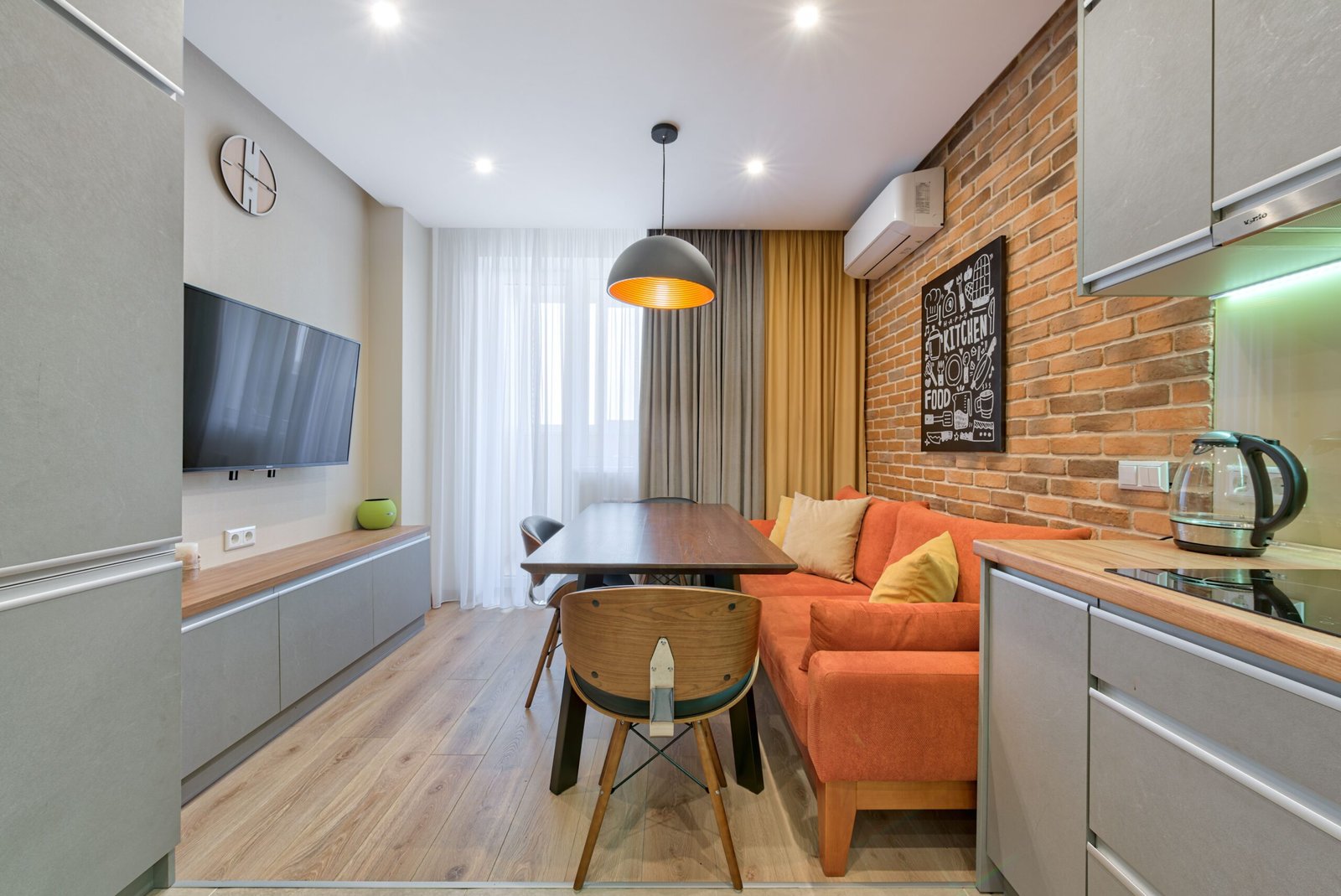
A small living room asks one question more urgently than a large one: how do you fit enough seating and enough storage into a room that barely has space for either? Most small-room advice treats these as separate problems — buy a smaller sofa, add a bookshelf — but in a small living room they are really one problem. Every piece of furniture takes up floor space, so every piece should ideally do more than one job, and every storage solution should leave the room feeling more spacious, not more crowded.
This guide treats seating and storage together. It covers how to choose seating for the room you actually have, storage that hugs the walls instead of eating the floor, multi-use pieces worth their space, and the habit that matters most in a small room: keeping the centre clear. The goal is not a room that looks empty, but a room that seats everyone comfortably and still has somewhere to put everything away.
Choose Seating for the Room You Have
The most common mistake in a small living room is buying seating for the room you wish you had. A large corner sofa that fills the room wall to wall may seat five people, but if it leaves no room to walk past it and no space for a table, it has made the room worse, not better. Start from the room’s measurements and its doorways, not from a showroom floor.
Measure the wall or walls where seating could go, and leave room for walkways on at least one side of each piece. Then think about how many people actually sit in the room at once, on an ordinary day rather than at a party. Many households need seating for two or three people daily and only occasionally need more. Designing for the daily number, with flexible extra seating for guests, usually produces a far more comfortable room than designing for the maximum number and living with the bulk every day.
Armless chairs, slim-armed sofas, and loveseats all save precious centimetres compared with their bulkier equivalents, and in a small room those centimetres add up to a walkway or a side table. Low-backed seating also helps, because it keeps sightlines open and makes the room feel less divided. A low sofa against a wall lets the eye travel over it to the wall beyond, which makes the room feel larger than a tall-backed sofa that cuts the room in half visually.
Consider seating that can be moved. Lightweight chairs, a pouffe, or a small stool can be pulled in when guests arrive and tucked away when they leave, which is far more practical in a small room than a permanent arrangement sized for visitors. Folding chairs have improved a great deal in recent years, and a pair stored in a cupboard or behind a door is a perfectly respectable solution for occasional seating — better, in fact, than a permanently oversized sofa that dominates the room all year.
Seating questions to answer before you buy
- How many people sit here on a normal evening, and how many only on special occasions?
- Which walls are long enough for a sofa, and which are broken up by doors, windows, or radiators?
- Can a chair be moved easily, or will it live in one spot permanently?
- Does the seating leave a clear path from the door to the main seat, and from the seat to the kitchen or hallway?
- Is there somewhere within arm’s reach of each seat for a drink, a book, or a phone?
Storage That Hugs the Walls
In a small room, floor space is the scarcest resource, so storage should take up as little of it as possible. Wall-hung storage is the obvious answer: shelves, wall-mounted cabinets, and picture ledges use wall space that would otherwise be empty, and they leave the floor clear. A shelf above a sofa or along a full wall can hold books, plants, and decorative items without taking a single centimetre of floor.
Built-in or floor-to-ceiling storage works on the same principle in reverse: by filling a whole wall from floor to ceiling, it removes the visual clutter of many small pieces and makes the wall read as architecture rather than furniture. This does not have to mean expensive fitted joinery. A row of identical bookcases, fixed to the wall and topped with a simple cornice, achieves much of the same effect at a fraction of the cost, and it can be taken apart if you move.
Shallow storage is your friend in a small room. A console or cabinet that is deep enough for books and media but shallow enough to sit close to the wall leaves the walkway clear, while a deep sideboard in the same spot eats into the room’s usable space. Measure the depth of any storage piece before you buy it, not just its width and height, and check that doors and drawers can open without hitting furniture or blocking a path.
The same wall-first thinking applies across the whole home. Small flats benefit from zoning and sightlines that keep rooms feeling open, as explained in Small Living Space Design: Layouts That Make a Flat Feel Larger, and bedrooms have their own version of this problem — see Small Bedroom Layout Ideas That Make the Most of Every Wall for how wall storage works in a small bedroom.
Multi-Use Pieces Worth the Space
In a small living room, a piece of furniture earns its floor space by doing two jobs. The classic example is a storage ottoman: it serves as a footrest, an extra seat, and a place to store throws, games, or children’s toys. A coffee table with a shelf or drawer underneath does the same for books and remotes. A sofa bed or a daybed turns a living room into a guest room without a second room. A side table with a drawer holds chargers and small items that would otherwise clutter a surface.
Not every multi-use piece is worth it, though. A piece that does two jobs badly — a sofa bed that is uncomfortable as both a sofa and a bed, for example — is worse than a single-purpose piece that does its one job well. Test multi-use furniture in person where possible, and be honest about which of its jobs you will actually use. A storage ottoman that you open daily is a triumph; a coffee table with a lift-top you never lift is just a heavier coffee table.
Nesting tables are another small-room favourite, and they deserve their reputation. A set of nesting tables gives you a full-size side table when you need it and almost no footprint when you do not, because the smaller tables slide away underneath. Similarly, a drop-leaf or gate-leg table can serve as a console most of the time and a dining table when guests arrive, which is invaluable in a home where the living room sometimes has to be the dining room too.
Keep the Centre of the Room Clear
If there is one rule that makes the biggest difference in a small living room, it is this: keep the centre clear. A room with a clear centre feels spacious even when its edges are full, because the eye reads the open floor as space to move and breathe. A room with furniture or clutter in the centre feels cramped even when its edges are empty, because every movement requires navigating around something.
Practically, this means resisting the temptation to put a large coffee table in the middle of a small room if it leaves no comfortable legroom, and choosing a smaller table, an ottoman, or no central table at all. It means keeping toys, bags, and laundry out of the middle of the floor, even if that requires a basket or a cupboard by the door where those things can live. And it means choosing a rug that defines the seating area without extending so far that it becomes a trip hazard in the walkway.
Visual clarity matters as much as physical clarity. A small room with low, light-coloured furniture and open sightlines feels larger than the same room with tall, dark furniture that blocks the view across it. That does not mean everything must be white — a dark sofa can look wonderful in a small room — but it does mean that tall, bulky pieces should be kept against walls, and the centre of the room should stay low and open.
Finally, a small room needs a regular reset more than a large room does, because clutter shows faster and takes up a larger proportion of the space. A basket for each person’s daily items, a place for remotes and chargers, and a two-minute tidy each evening will keep a small living room feeling spacious in a way that no amount of clever furniture can achieve on its own. For households where a small living room also has to function as a workspace, the same reset habit is central to Home Office Organization Ideas for a Calmer Workday, which covers keeping a work area tidy when it shares space with the rest of the home.
FAQ: Small Living Rooms
Should I choose a sofa or two chairs in a small living room?
It depends on how you sit. A small sofa usually seats two people more comfortably than two separate chairs and takes up less visual space, but two chairs are more flexible: they can be moved, angled for conversation, or used elsewhere when guests arrive. If you regularly sit with one other person, a loveseat plus one chair is often the best compromise.
How can I add storage without making the room feel smaller?
Use the walls, keep storage shallow, and choose pieces that match the wall colour or are low and unobtrusive. Closed storage — cupboards and cabinets rather than open shelves — also helps, because it hides visual clutter. A room with one large, closed storage wall often feels calmer than a room with many small open shelves full of objects.
Is a corner sofa a good idea in a small room?
Sometimes. A corner sofa uses a corner that might otherwise be wasted, and it can seat more people than a straight sofa of the same length. But it also fixes the layout permanently and can dominate a small room. Measure carefully, check that it leaves walkways clear on all sides, and consider whether a smaller sofa plus a chair would give you the same seating with more flexibility.
What do I do with things that have no storage home?
That is the real question behind most small-room storage problems. Before buying more storage, sort through what you have and decide what actually belongs in the living room. Items that belong elsewhere should be moved, not stored in the living room. Storage works best when it holds things that genuinely live in that room, rather than things that have nowhere else to go.
Conclusion
A small living room works when seating and storage are planned together, not separately: seating chosen for the people who actually use the room, storage that hugs the walls and leaves the floor free, multi-use pieces that earn their space, and a clear centre that keeps the room feeling open. Start by measuring and by being honest about what the room must hold, then let every piece justify the floor it takes up. A small room, planned this way, does not feel like a compromise — it feels like a room that was thought about, and that is a far more comfortable place to live in.