
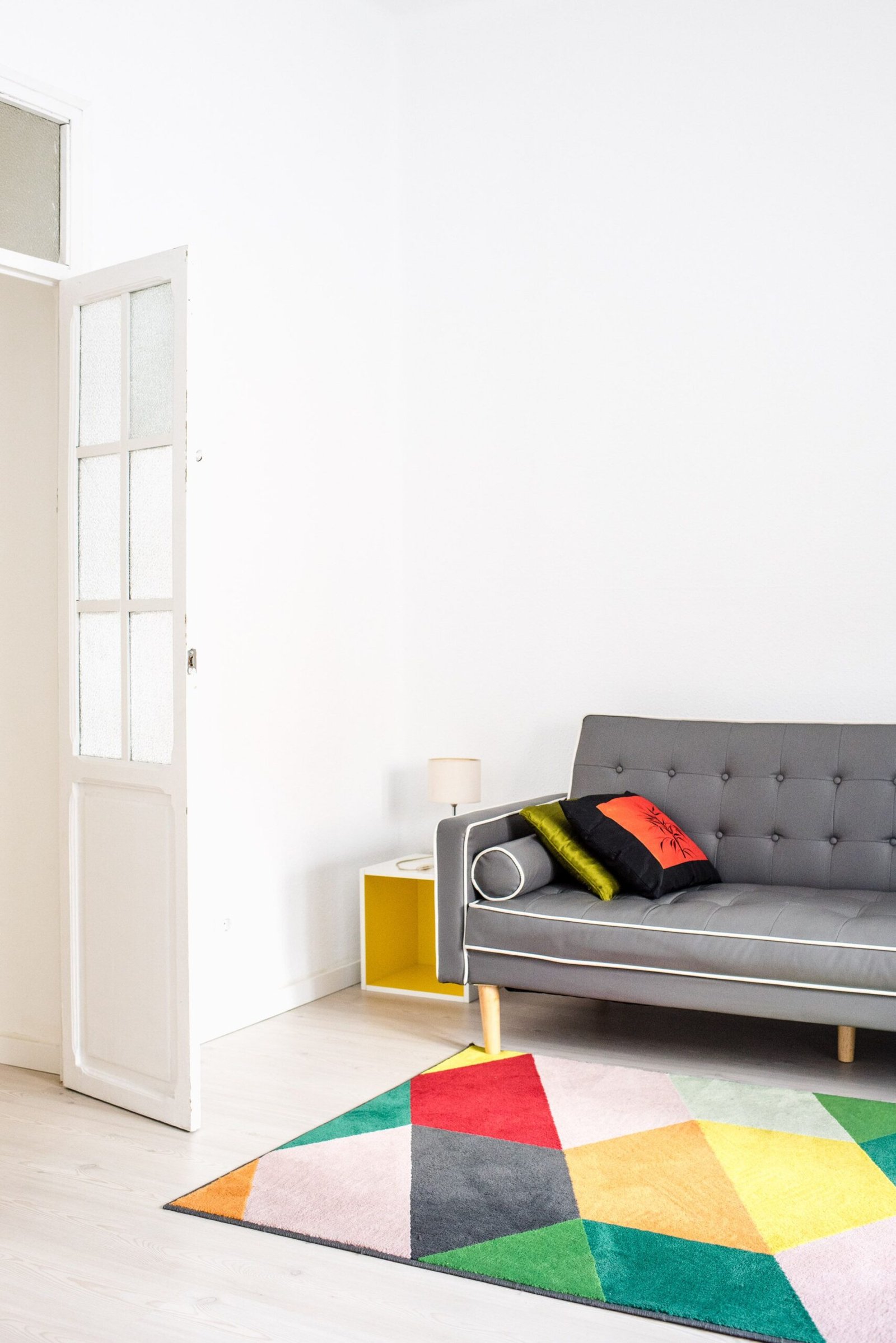
The sofa is usually the largest, most expensive, and longest-lasting item in a living room, and it is often bought before the rest of the room is planned. That leaves many people with the same question: now that I have this sofa, what colours go with it? A grey sofa, a brown sofa, a blue sofa, a cream sofa — each one suggests a different direction, and choosing wall colours, rugs, and curtains around it can feel surprisingly difficult.
This guide starts from the sofa you already own. It explains how to read your sofa’s undertone, how warm, cool, and neutral sofas each pair with different schemes, how to combine walls, rugs, and curtains, and how to add colour in layers that can be changed easily. The aim is a living room colour scheme that works with your sofa rather than fighting it, and that you can adjust over time without repainting the whole room.
Start From Your Sofa’s Undertone
Every sofa colour has an undertone — a hint of warmth or coolness underneath the main colour — and that undertone is what determines which other colours will harmonise with it. A grey sofa, for example, is rarely just grey. It may be a warm grey with a hint of brown or beige, a cool grey with a hint of blue, or a true neutral grey with neither. A brown sofa may lean warm and reddish or cool and ashy. A cream sofa may be warm and yellowish or cool and stark.
Finding your sofa’s undertone is easier than it sounds. Hold a piece of white paper next to the sofa in daylight: a warm undertone will make the white look slightly cool by comparison, and a cool undertone will make it look slightly warm. Or compare the sofa with items you know: a warm grey sofa looks browner next to a cool grey cushion, and a cool grey sofa looks bluer next to a warm beige one. This is not an exact science, and you do not need to get it perfectly right — you just need a general sense of whether your sofa leans warm, cool, or neutral.
Why does this matter? Because colours with the same undertone tend to sit comfortably together, while colours with clashing undertones can feel subtly wrong even when they look fine individually. A warm grey sofa with cool blue walls can feel disconnected; the same sofa with warm greige walls feels coherent. A cool grey sofa with warm yellow walls can feel jarring; with soft blue-grey or white walls, it feels calm. Matching undertones is the single most useful rule in this whole guide, and it applies to walls, rugs, curtains, and cushions alike.
If you are choosing a whole-home palette rather than just a living room scheme, the same undertone thinking scales up. How to Choose a Colour Palette for Your Whole Home explains how to pick a small, repeatable palette — one neutral you can live with, plus two accents — that flows between rooms without making every room identical.
Warm Sofas, Cool Sofas and Neutrals
Warm sofas — brown, tan, terracotta, warm beige, and warm grey — pair naturally with warm neutrals and earth tones. Walls in warm white, soft beige, warm greige, or muted sage give a warm sofa room to breathe without competing with it. Accent colours that work well include rust, ochre, olive, deep green, and warm gold, all of which echo the sofa’s warmth without matching it exactly. The aim is harmony, not a matching set: a brown sofa with a rust cushion and an olive throw feels richer than a brown sofa with brown cushions.
Cool sofas — blue, cool grey, charcoal with a blue hint, and cool-toned green — pair naturally with cool neutrals and soft, muted colours. Walls in cool white, pale blue-grey, or soft sage-grey suit a cool sofa, and accent colours such as dusty blue, muted teal, soft lavender, and silver-grey extend the cool feeling without making the room feel cold. To keep a cool scheme from feeling chilly, add warmth through texture rather than colour: a wool throw, a wooden coffee table, warm-toned wood flooring, or warm lamplight all soften a cool palette without changing its undertone.
Neutral sofas — true grey, cream, white, and black — are the most flexible, because they have little undertone to clash with. A neutral sofa can take almost any accent colour, which is both a freedom and a trap: with no undertone to guide you, it is easy to add too many colours at once and end up with a room that feels busy. The solution is to choose two or three accent colours and repeat them, rather than introducing a new colour with every cushion. A cream sofa with navy and ochre accents, repeated in the rug, cushions, and art, feels intentional; the same sofa with six unrelated accent colours feels scattered.
Schemes by sofa colour
- Grey sofa (warm): warm white walls, beige or greige rug, rust or ochre cushions, wood tones for warmth.
- Grey sofa (cool): cool white or blue-grey walls, soft grey rug, dusty blue or teal cushions, silver or light wood accents.
- Brown sofa: warm neutral walls, patterned rug with warm tones, cream and olive or rust cushions, leather or wood details.
- Blue sofa: pale grey or white walls, neutral rug with a blue thread, cream and muted gold cushions, natural wood.
- Cream or white sofa: any wall colour you like, with two or three chosen accents repeated in cushions, throws, and art.
- Green sofa: warm white walls, natural rug, cream and terracotta cushions, wood and brass or rattan details.
Colour also affects how a room feels, not just how it looks — a point worth understanding before you commit to a scheme. Colours tend to feel different in different rooms and in different light, and personal taste matters more than any single rule, as explained in Colour Psychology at Home: Choosing Colours Room by Room. For a broader background on how colour is understood, the colour psychology overview is a useful general reference, though it is worth remembering that its findings are general tendencies, not rules for your particular room.
Wall, Rug and Curtain Combinations
Once you know your sofa’s undertone, the next step is to combine the three largest surfaces in the room: walls, rug, and curtains. These three do most of the colour work, and getting them right makes everything else easier. The simplest reliable formula is: walls in a light neutral that matches the sofa’s undertone, a rug that introduces pattern or a second colour, and curtains that either match the walls (for a calm, seamless look) or pick up an accent colour from the rug (for a more decorated look).
Walls are the background, so they should usually be the quietest element. A light neutral wall colour — warm white, cool white, pale greige, or pale sage — gives the room light and lets the sofa, rug, and furniture provide the interest. A darker wall colour can work beautifully as a single feature wall behind the sofa, but painting all four walls dark in a small or poorly lit room can make it feel smaller, so test a dark colour on one wall first.
The rug is where pattern and colour can be introduced safely, because a rug is large enough to matter but easy to change. A patterned rug can tie together a sofa, cushions, and curtains by containing all of their colours in one place, which is why interior designers often start a scheme from a rug rather than from a wall colour. If your sofa is patterned or strongly coloured, a plain rug in a neutral tone is safer; if your sofa is plain, a patterned rug adds the interest the room needs.
Curtains are often overlooked, but they cover a large area and affect the room’s colour balance significantly. Curtains that match the wall colour make windows disappear and the room feel larger and calmer. Curtains in an accent colour make the windows a feature and add depth. Either approach works, but curtains in a colour that clashes with the sofa’s undertone will fight the whole scheme, so check them against the sofa in daylight before committing.
Add Colour in Small, Changeable Layers
The safest way to add colour to a living room is in layers that can be changed without repainting or reupholstering: cushions, throws, art, books, plants, and small decorative items. These layers let you experiment with colour, follow the seasons, and refresh the room without a major project. If a colour does not work, a cushion can be swapped in minutes; a wall colour cannot.
A practical rule is to choose one main accent colour and one secondary accent, and to repeat each at least twice in the room. A rust cushion on the sofa, a rust vase on a shelf, and a rust thread in the rug create a thread of colour that ties the room together. A single rust item on its own looks like an accident; three rust items look like a decision. The same applies to any accent colour, and it is one of the simplest ways to make a room look considered rather than assembled by chance.
FAQ: Living Room Colour Schemes
What wall colour goes with a grey sofa?
It depends on the grey’s undertone. Warm grey sofas suit warm white, beige, or greige walls; cool grey sofas suit cool white or pale blue-grey walls; true neutral grey suits almost any light neutral. Hold paint samples against the sofa in daylight to check the undertone before deciding.
Can I mix warm and cool colours in one living room?
Yes, but carefully. A room that is mostly warm with one cool accent, or mostly cool with one warm accent, can feel balanced and interesting. A room that is half warm and half cool, with no dominant undertone, tends to feel unsettled. Choose a dominant undertone and let the other appear only in small accents.
Should curtains match the sofa or the walls?
Either works, and the choice changes the room’s feeling. Curtains matching the walls make the room feel larger and calmer; curtains matching or complementing the sofa make the windows a feature. What matters most is that the curtain colour’s undertone does not clash with the sofa’s.
How many accent colours should a living room have?
Two or three, repeated. One accent can feel flat, two or three feel rich, and more than three usually feels busy unless the room is very large and the colours are carefully related. Repeat each accent at least twice so it reads as a deliberate choice.
Conclusion
A living room colour scheme that works with any sofa starts with the sofa itself: read its undertone, choose walls and a rug that harmonise with it, and add colour in small, changeable layers that you can adjust over time. Warm sofas want warm neutrals and earth tones, cool sofas want cool neutrals and muted blues and greys, and neutral sofas can take almost any accent — provided you limit yourself to two or three and repeat them. Get the undertone right, and the rest of the scheme falls into place far more easily than it first appears.