
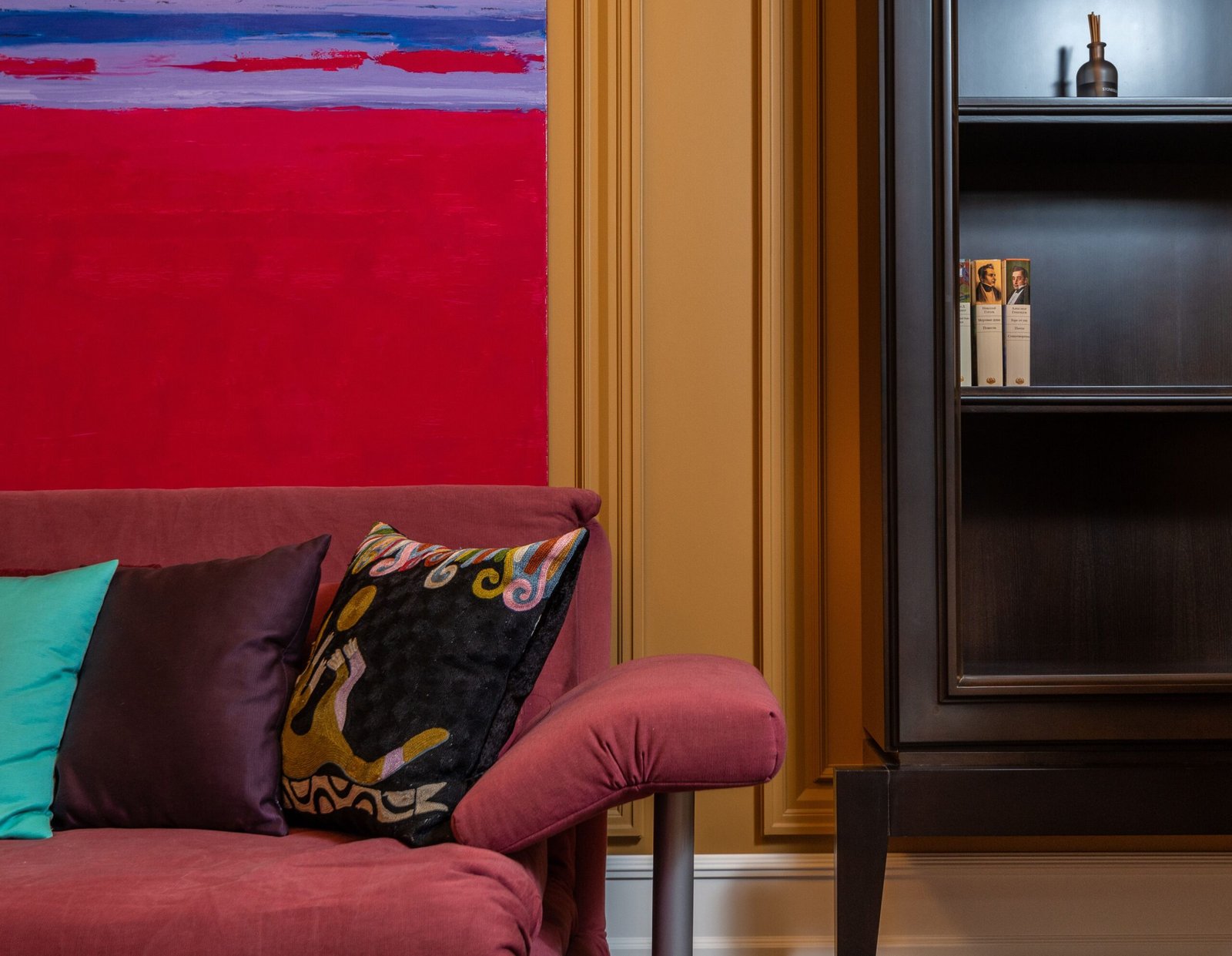
Almost every home has one: the sofa in a colour you fell for at first sight, the painting that stopped you in a gallery, the rug you brought home even though it matched nothing you already owned, or the fireplace that was the reason you chose the house. A statement piece is not a problem to solve. It is a starting point — and a very good one, because it gives the room something to organise around.
The trouble usually starts afterwards. Faced with one bold item, it is tempting to play it too safe, so the room ends up pale and forgettable, or to keep adding other bold things in the hope that they will balance each other out. Neither works well. A room succeeds when everything else supports the star, echoes it quietly, and then gets out of its way. This guide explains how to design a room around a statement piece you already own, whether that piece is a sofa, a work of art, a rug, or a fireplace.
Choose One Focal Point, Not Three
The first rule is also the simplest, and the easiest to break: a room should have one focal point, not three. The eye needs somewhere to land when it enters a room. If it is offered a bold sofa, a dramatic gallery wall, and a patterned rug all at once, it does not know where to look, and the room feels restless rather than exciting.
That does not mean the rest of the room has to be boring. It means the other elements should play supporting roles. If your piece is a sofa, the artwork above it should complement it rather than shout over it. If it is a painting, the sofa beneath it should be a calm frame for the art, not a second star. If the fireplace is the focal point, arrange the furniture to face it, not around a television competing from the opposite wall.
Choosing one focal point also makes decisions easier. Once you have named the star, every other choice gets a simple test: does this item support it, or distract from it? A cushion that picks up a colour from the artwork passes. A second large pattern that fights with the rug does not. A bright accent chair that pulls the eye to another corner does not, unless you have decided that chair is the statement piece instead.
How to spot a second focal point creeping in
- When you photograph the room, does your eye jump between spots instead of settling in one place? That usually means competing focal points.
- Have you added a bold item to “balance” the first one? Balancing a bold piece usually calls for calm, not a second bold piece.
- Does one corner feel like a separate display? A gallery wall, bright chair, or patterned curtains can quietly become a rival if much louder than the rest.
If you find a rival, you do not necessarily have to remove it. Sometimes toning it down is enough: swapping a bright cushion for a neutral one, or choosing plainer curtains so the window does not compete with the artwork. The goal is a clear hierarchy, with the statement piece first and everything else supporting it. The principles behind focal point room design — proportion, balance, and flow — are explained in Interior Design Basics: Proportion, Balance and Flow, a useful companion to this guide.
Let the Statement Piece Set the Scale
A statement piece does more than set the mood of a room. It also sets the scale, and getting this right is what makes a room feel comfortable rather than awkward. A large sofa needs substantial companions: a coffee table that is not lost in front of it, a rug large enough to anchor it, and lamps tall enough to hold their own beside it. A delicate chair, by contrast, can be overwhelmed by a huge, heavy coffee table placed next to it.
Start with the floor plan, not with shopping. Measure the statement piece and the room, and sketch roughly where the main items will go. Leave sensible walkways, enough room to pass comfortably without turning sideways, and make sure the main seating faces the focal point rather than turning its back on it. If the statement piece is a fireplace, the seating should let people enjoy both the fire and conversation. If it is a sofa, the coffee table, side tables, and lighting should form a group around it.
Scale also applies to the rug, where many rooms go wrong. A rug too small for the seating area makes even a beautiful sofa look as though it is floating, and breaks the room into disconnected islands. As a guide, the front legs of the sofa and chairs should sit on the rug, and it should extend beyond the coffee table on all sides. If the rug is the statement piece, this matters even more: too small, and it looks like a mat rather than a foundation.
Keep Competing Items Quiet
Once the focal point and scale are settled, keep everything else quiet enough to let the star shine. Quiet does not mean white, plain, or characterless. It means other items should not demand the same attention as the statement piece. If the star is colourful, supporting pieces can be neutral but rich in texture. If it is patterned, they can be solid colours. If it is large and dramatic, they can be simpler in shape.
Colour is the easiest way to quieten a room. Choose a restrained palette for supporting pieces — two or three colours at most — and let the statement piece carry the strongest colour or pattern. Neutral need not mean grey or beige: soft greens, warm creams, muted blues, and natural wood tones can all act as quiet backgrounds. Texture helps too: linen, wool, wood, and basketweave add warmth and layering without a competing pattern.
For statement sofa styling, choosing colours to sit alongside a bold sofa deserves some care. Living Room Colour Schemes for Any Sofa offers practical palettes that keep the sofa as the hero while the rest of the room feels considered rather than washed out.
Common mistakes in how to style a bold piece
- Matching the bold piece too literally. Cushions, curtains, and a rug all in exactly the same bright colour can make the room feel like one block of colour. Echo the colour; do not repeat it everywhere.
- Adding a second pattern “to tie it together.” A second strong pattern rarely ties a room together; a solid colour from the statement piece usually works better.
- Over-decorating nearby surfaces. A mantelpiece crowded with ornaments distracts from a fireplace. Leave some surfaces calm.
- Choosing furniture too small or fussy next to a large piece. Spindly side tables beside a deep sofa can look apologetic; choose pieces with enough visual weight.
Connect the Piece With Colour or Texture
Keeping competing items quiet is only half the job. The other half is making sure the statement piece actually belongs in the room, rather than looking as though it wandered in from somewhere else. The way to do that is connection: repeating something from the statement piece — a colour, a texture, a material, or a shape — in smaller, quieter ways elsewhere in the room. These echoes are what make a room feel designed rather than assembled.
Colour is the most straightforward echo. Pick one or two colours from the statement piece and repeat them in small doses: a cushion, a throw, or a vase. The echoes should be related but not identical in strength. If the sofa is deep teal, a softer teal cushion and a muted teal vase connect the room without turning it into a teal theme park. The statement piece carries the colour at full strength; the echoes carry it at a whisper.
Texture and material work the same way, and are especially useful when the piece is neutral in colour but bold in texture or form. A boucle armchair can be echoed with a wool throw and a textured cushion. A wooden table can be echoed with wooden frames or a tray in a similar tone — in small doses, not on every surface.
Think of echoes as a trail, not a fence. Two or three, spread around the room, are enough to lead the eye from the statement piece to the rest of the space and back. Five or six in every corner feel repetitive and undo the calm a clear focal point brings. If the piece feels isolated, add one echo; if the room feels busy, remove one. Open shelving is a good place for echoes, as it is visible without being dominant; How to Style Open Shelving covers grouping, height, and breathing room.
A simple five-step process
- Name the statement piece and what makes it stand out — colour, pattern, scale, texture, or shape.
- Check the scale: do the rug, coffee table, seating, and lighting sit comfortably alongside it?
- Remove or tone down anything competing with it, starting with the loudest pattern or colour.
- Add two or three quiet echoes of its colour, texture, or material elsewhere in the room.
- Live with the room for a few days before buying anything else; small adjustments often finish the job.
FAQ: Designing Around a Statement Piece
Can a room have more than one statement piece?
It can, but only if the pieces are in different rooms or clearly separated zones, or if one is obviously dominant and the other is much quieter. In a single open-plan space, two bold pieces in the same sightline will usually compete. If you love both, give each its own room or its own corner, and let the rest of that space stay calm.
What if my statement piece is a colour I find hard to live with?
Surround it with neutrals and natural textures, and add only small echoes of the colour rather than repeating it boldly. A calm room and warm lighting make a strong colour much easier to live with. If it still feels too much, a throw, a slipcover, or a less central spot can soften its impact.
Should the statement piece be the most expensive item in the room?
Not necessarily. A statement piece earns its role by being visually striking, not by costing the most. A second-hand find, a handmade rug, or a painting by a local artist can be a statement piece if it has presence and you love it. What matters is how the rest of the room treats it, not what you paid for it.
How do I design around a statement piece in a small room?
The same principles apply, with even more emphasis on scale and restraint. Choose a piece that fits the room — a bold colour on a sensibly sized sofa, rather than an oversized item that leaves no room to move. Keep supporting pieces compact, leave clear walkways, and use light wall colours to keep the room feeling open.
Conclusion
Designing around a statement piece is an exercise in confidence and restraint: confidence to let one beautiful thing lead, and restraint to let everything else support it. Choose a single focal point, let it set the scale, keep its rivals quiet, and connect it with a few echoes of colour or texture. Do that, and the piece you already love becomes the reason the whole room works.
1 thought on “How to Design a Room Around a Statement Piece”