Open shelving in the kitchen divides opinion more than almost any other design choice. Its fans love the airiness, the easy reach, and the chance to display crockery that would otherwise hide behind doors. Its critics point to the dust, the grease, and the constant tidiness it demands, and argue that a kitchen is a working room, not a display case. Both sides are right, which is why the honest answer to open shelving is not yes or no, but when, where, and how much.
This guide gives that honest answer. It covers when open shelving works beautifully, when closed cabinets are the better call, a hybrid approach that gets the best of both, and how to keep open shelves clean and tidy if you choose them. The goal is a decision based on how you actually cook, clean, and live — not on a photograph of someone else’s kitchen.
When Open Shelving Works Beautifully
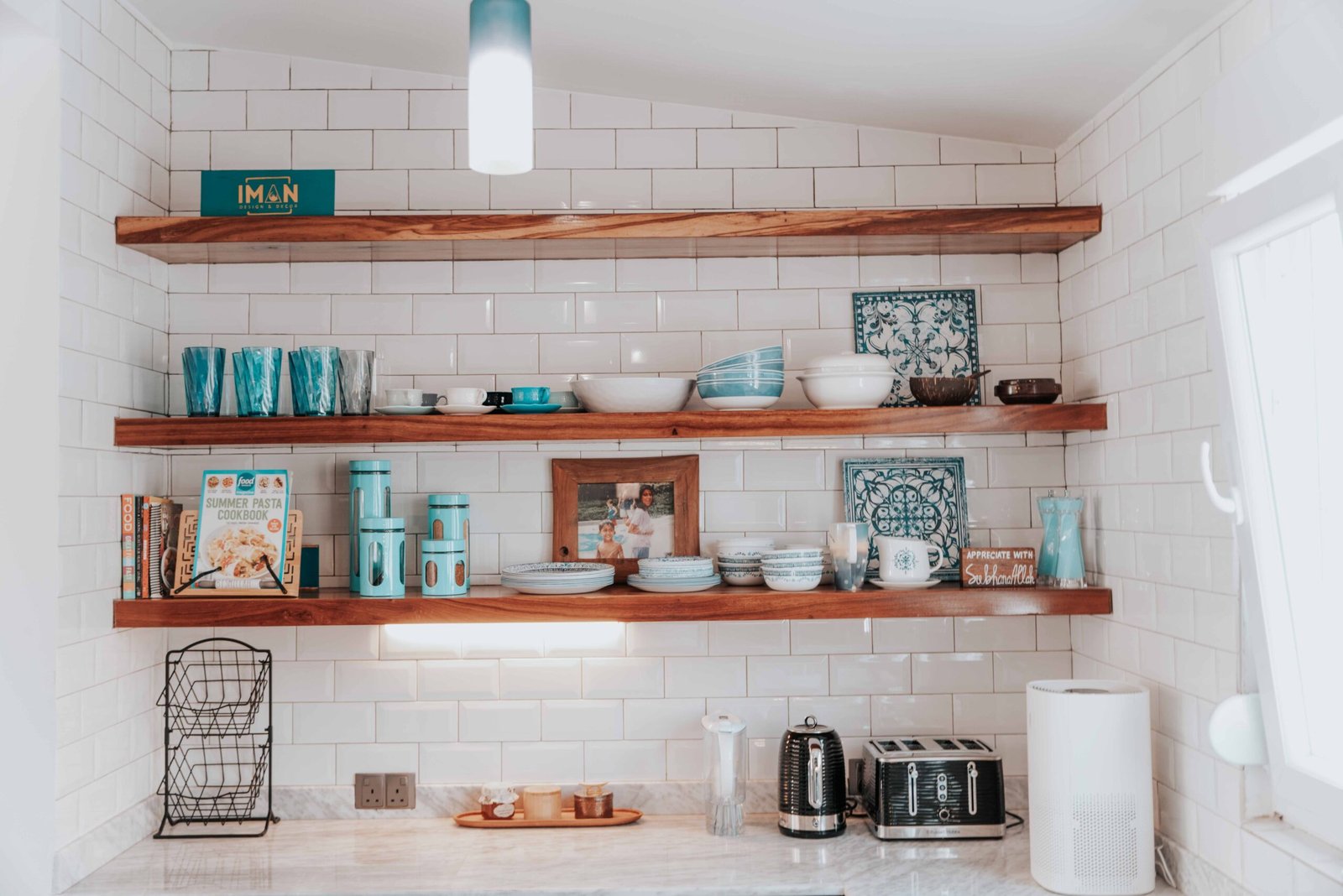
Open shelving works best in kitchens where the things on the shelves are used daily, look good, and are easy to keep clean. Daily-use crockery — plates, bowls, mugs, glasses — fits that description perfectly: it is taken down and washed constantly, so it never gathers dust, and a stack of matching plates or a row of glasses looks genuinely attractive on a shelf. The same applies to a few well-chosen jars, a set of cookbooks that are actually consulted, or a plant that softens a wall.
Open shelving also works well in small or dark kitchens, because it removes the visual bulk of wall cabinets. A wall of closed cabinets can make a small kitchen feel boxed in, while open shelves on the same wall keep sightlines open and let light travel further. In a kitchen with a beautiful wall — brick, tile, or a colour worth showing — open shelves display the wall itself rather than hiding it behind doors, which is a genuine aesthetic gain.
It works best, too, for cooks who like everything visible and within reach. A cook who reaches for the same plates, bowls, and oils every day will find open shelves faster than opening and closing doors, and will enjoy the feeling of a kitchen where everything is to hand. For that cook, open shelving is not a display choice; it is a workflow choice, and it makes cooking feel easier rather than more demanding.
Finally, open shelving works when it is limited. One or two shelves, holding a defined set of items, are easy to keep tidy and clean. A whole kitchen of open shelves, holding everything the kitchen owns, is a different proposition entirely. The kitchens in photographs that make open shelving look effortless almost always show a small number of shelves, carefully styled, in a kitchen that also has plenty of closed storage elsewhere. That proportion — a little open, mostly closed — is the secret behind most successful open shelving.
When Closed Cabinets Are the Better Call
Closed cabinets are the better call in kitchens where dust, grease, or clutter are real problems — which is to say, in most busy, real kitchens. A kitchen near a busy road, a kitchen with pets, a kitchen where frying happens often, or a kitchen shared by a large household will all deposit dust and grease on open shelves far faster than a photograph suggests. Items on open shelves near a hob need wiping far more often than items behind doors, and that wiping becomes a chore that is easy to resent.
Closed cabinets are also better for mismatched, unattractive, or rarely used items. A collection of plastic containers, a jumble of baking tins, a set of mugs that do not match, a blender that is used monthly — none of these looks good on display, and none of them benefits from being visible. Behind a door, they are simply stored. On a shelf, they are on show, and they make the kitchen look cluttered even when it is, by any reasonable standard, tidy.
Households with young children or with limited time for tidying should also favour closed cabinets. Open shelves demand a level of tidiness that is hard to maintain when life is busy: every item must be put back neatly, in its place, every time, or the shelf looks messy. Closed doors forgive a hurried put-away. A cabinet whose contents are slightly jumbled behind a closed door still looks tidy from the room; a shelf with the same jumble does not.
Cost and practicality also favour closed cabinets in many cases. Wall cabinets provide more storage per metre than open shelves, because they are deeper and can hold items in two rows. They also protect items from light, which fades packaging and, over time, can affect oils and spices stored in clear containers. For a kitchen where storage space is tight, replacing wall cabinets with open shelves usually means losing storage, and that loss must be made up elsewhere — which is rarely easy in a small kitchen.
A Hybrid Approach That Gets Both
The hybrid approach — mostly closed cabinets, with a small amount of open shelving in the right places — gets the benefits of both without the drawbacks of either. The usual formula is one or two open shelves, in a spot that is easy to reach and easy to clean, holding daily-use items that look good, while everything else lives behind doors. That formula is popular because it works: it gives the airiness and easy reach of open shelving, without the dust, grease, and tidiness burden of a whole open kitchen.
Good hybrid spots include a shelf beside the hob for oils and utensils used daily, a shelf above a coffee station for mugs and jars, or a single shelf at the end of a run of cabinets that would otherwise be a dead corner. A glazed cabinet — a door with glass panels — is another hybrid option: it gives the display effect of open shelving while protecting items from dust and grease, and it is a good compromise for items that look good but are not used daily enough to stay clean on an open shelf.
The hybrid approach also lets a kitchen change over time. A shelf that holds daily crockery now can hold something else later, and a glazed cabinet can be changed from display to closed storage simply by changing what is in it. That flexibility is valuable in a kitchen, because cooking habits, household size, and tastes all change over years, and a layout that can adapt without rebuilding is a layout that lasts.
When planning a hybrid, keep the open portion small and deliberate. Decide what will live on the open shelves before they are installed, count the items, and check that they genuinely fit and look good together. An open shelf installed without a plan for its contents will fill with whatever is nearest, and that is how open shelving earns its reputation for clutter. A shelf with a plan — daily plates, a few jars, a plant — stays a feature. Styling open shelves so they look intentional rather than cluttered is a skill in itself, covered in How to Style Open Shelving Without It Looking Messy, and it applies to kitchen shelves just as it does to living-room ones. Organising the closed cabinets alongside them, so everything has a home whether it is displayed or hidden, is covered in How to Organize Kitchen Cabinets So Everything Is Easy to Reach.
Keeping Open Shelves Clean and Tidy
If you choose open shelving, keeping it clean and tidy requires a system, not just good intentions. The first rule is rotation: items on open shelves should be used regularly, so they are washed and returned often, which prevents dust building up. An item that sits on an open shelf untouched for months will gather dust and grease, however clean the kitchen is, and it will need washing before it can be used — which defeats the purpose of easy reach.
The second rule is a limit: decide how many items each shelf holds, and stick to it. A shelf that is full to the edges looks cluttered and is hard to clean, because every item must be moved to wipe the shelf. A shelf with space around its items looks intentional, is easy to wipe, and makes it obvious when something is out of place. The space is not wasted; it is what makes the shelf work as display rather than storage.
Cleaning open shelves should be part of a routine, not a deep clean. A quick wipe once a week, while the kitchen is being cleaned anyway, keeps dust and grease from building up to a level that requires a major effort. Shelves near the hob need wiping more often, because cooking grease travels, and a shelf that is wiped weekly will never reach the sticky, grimy state that makes open shelving feel like a mistake.
Finally, have a closed home for overflow. When a shelf fills up, or when an item does not look good on display, it should have a cabinet to go to, rather than crowding the shelf. A shelf that can overflow into a cabinet stays tidy; a shelf with nowhere else for its items to go will inevitably become cluttered. That overflow home is part of the system, and it is what keeps open shelving sustainable over years rather than weeks. A budget makeover that adds a single open detail — one cabinet with its doors removed, for example — follows the same logic, as discussed in Budget Kitchen Makeover Ideas That Don’t Require New Cabinets, where one open feature is treated as a finishing touch rather than a whole-kitchen commitment.
FAQ: Kitchen Open Shelving
Does open shelving make a kitchen dusty?
Items used daily stay clean because they are washed often, but items left untouched on open shelves do gather dust and, near a hob, grease. The answer is to keep only daily-use items on open shelves and to wipe the shelves weekly as part of the normal kitchen clean.
How much open shelving should a kitchen have?
Less than you think: one or two shelves, holding a defined set of daily items, in a kitchen that also has plenty of closed storage. A whole kitchen of open shelves demands constant tidiness and loses storage space, while a small amount gives airiness and easy reach without those costs.
What looks good on open kitchen shelves?
Matching daily crockery, glasses, a few jars, cookbooks that are actually used, and a plant. Mismatched containers, rarely used gadgets, and plastic items generally do not look good on display and are better behind doors.
Is open shelving cheaper than wall cabinets?
Often, yes, because shelves and brackets cost less than cabinet carcasses and doors. But the saving can be false economy if the shelves replace storage that is then needed elsewhere, or if the kitchen needs additional closed storage to compensate for what was lost.
Conclusion
Open shelving in the kitchen is not a yes-or-no choice. It works beautifully for daily-use items that look good and are washed often, in a limited amount, in a kitchen that also has closed storage. It works badly as a whole-kitchen system in a busy, dusty, or grease-prone kitchen, or for items that do not look good on display. The hybrid — a little open, mostly closed, with a plan for what lives on the shelves and a routine for keeping them clean — is the answer for most kitchens, because it gives the airiness and easy reach of open shelving without its burdens. Choose open shelving by how you cook and clean, not by how it looks in a photograph, and it will serve you well.
1 thought on “Open Shelving in the Kitchen: When It Works and When It Doesn’t”